THE SHORT VERSION
- A tank keeps a full load of hot water ready and reheats it around the clock. It is usually the cheapest heater to buy and install: Home Depot publishes $1,600–$2,400 installed for a standard gas or electric tank.
- Electric tanks have two elements, but only one heats at a time, so they recover about half as fast as gas. A 50-gallon electric tank may deliver 62 gallons in its first hour; a 50-gallon gas tank, 89.
- For gas, the vent decides the job. A same-type atmospheric swap is simplest. Power vent, direct vent and condensing tanks need an outside wall, a 120-volt outlet or a drain, and cost more.
- High efficiency means condensing. Every gas tank on ENERGY STAR’s list (checked October 4, 2026) is a power-vented model rated 0.86–0.90 UEF, against 0.60–0.73 for the standard gas models in our table.
- Federal rules shape what you can buy. Since 2015, electric tanks over 55 gallons must perform like heat pumps, with one narrow exception. A 2024 rule, still on the books, extends that to most electric tanks of 20–55 gallons made from May 6, 2029.
A tank keeps hot water ready and pays for it in standby loss
A storage water heater is an insulated steel tank with a heat source. Cold water enters at the top and a dip tube carries it to the bottom. Hot water rises and leaves from an outlet at the top, so the hottest water is always the first water out. A thermostat keeps the whole tank at its set temperature whether or not anyone is using it.
That readiness has a cost. Heat leaks out through the jacket and, on gas tanks, up the flue, all day. This standby loss is why the federal efficiency standards for tanks are written as a sliding scale: the bigger the tank, the lower the minimum rating, because a bigger tank has more surface to lose heat from. It is also why oversizing costs you money; see what size water heater you need.
Gas and electric tanks share the same plumbing. They differ in how they heat, how fast they recover after a run of showers, and what has to be connected to them: a 240-volt circuit for electric, a gas line and a vent for gas.
Electric tanks heat with two elements, one at a time
A standard electric tank has two heating elements screwed through the side of the tank, one in the upper third and one near the bottom. Each has its own thermostat, pressed against the tank wall behind an access panel. Rheem’s technical bulletin describes the usual arrangement as non-simultaneous: “only one of the heating elements, either the upper OR the lower, may heat at a time.”
The upper thermostat has priority
After a big draw, the upper element heats the top of the tank first, so you get some hot water back quickly.
Then power switches to the lower element
Once the top is satisfied, the upper thermostat relays power to the lower thermostat, which heats the rest of the tank.
The ECO stands guard
The energy cut-off (ECO) on the upper thermostat trips if the tank gets too hot. Rheem’s advice: if it trips often, “call your water heater professional.” The parts behind the access panels carry 240 volts.
Because only one element runs, recovery depends on the wattage of one element. Rheem’s spec sheet gives the arithmetic: watts ÷ 2.42 ÷ temperature rise. A 4,500-watt element recovers about 21 gallons per hour at a 90°F rise, roughly half the 43 gallons per hour of a 40,000 BTU/h gas burner. That is why Rheem’s 50-gallon Performance Plus electric tank has a first-hour rating of 62 gallons and Bradford White’s 50-gallon gas tank has 89.
Electric tanks have strengths too. There is no vent, no gas line and no combustion, so they can go in a closet or under a stair where a gas tank could not. Their efficiency rating looks high (UEF 0.92–0.93 on current models from A.O. Smith and Rheem) because almost all the electricity ends up in the water. But UEFs compare heaters only within the same fuel and usage bin, so compare running costs too; see gas vs. electric. ENERGY STAR heat pump tanks typically rate 3.3–4.1, doing the same job on a fraction of the electricity; see heat pump water heaters.
Gas tanks: the vent decides how hard the job is
Every gas tank burns fuel and must send the exhaust outdoors. How it does that splits gas tanks into five families, and the family usually decides what a replacement involves. If the new tank vents the same way as the old one, the installer can usually reuse the existing vent, provided it is sound and correctly sized. If it doesn’t, the job grows.
| Type | How it vents | Site needs | Example UEF | Cost vs. atmospheric |
|---|---|---|---|---|
| Electric | No vent | 240-volt circuit | 0.93 (Rheem Performance Plus) | Similar |
| Atmospheric gas | Exhaust rises up a metal vent | Vertical vent, room air; no power | 0.64 (A.O. Smith GUR-50) | Baseline; simplest swap |
| Direct vent gas | Sealed; one wall pipe, no fan | Outside wall close by; no power | 0.60 (A.O. Smith GDV-40, 40 gal) | Higher |
| Power vent gas | Blower pushes exhaust out a wall | 120-volt outlet; new vent | 0.72 (A.O. Smith GPVL-50) | Higher |
| Power direct vent gas | Sealed; blower; two long pipes | 120-volt outlet; new vent | 0.73 (A.O. Smith GPDX-50L) | Higher |
| Condensing gas | Power-vented through plastic pipe | 120-volt outlet; condensate drain | 0.88–0.90 (Rheem Maximus, A.O. Smith Vertex HV) | Highest: about $800 more (DOE) |
Sources: manufacturer product pages and spec sheets (UEF as listed, checked October 4, 2026); Rheem, “Gas Water Heater Types Explained” (2026), which says power vent models “typically cost more”; DOE 2024 final rule, Table V.2 (average installed cost in 2022 dollars: $1,432 for a baseline gas tank, $2,241 for the top condensing level, 20–55 gallons). DOE also counts a new vent and, for direct vent, a combustion-air intake as added installation costs. Home Depot’s published range for a standard gas or electric tank is $1,600–$2,400 installed.
Why changing the vent type changes the price
When DOE costed out more efficient gas tanks for its 2024 rule, it added installation costs for power-vented and condensing models that a same-type atmospheric swap doesn’t have: a new vent, a combustion-air intake for direct vent units, concealing vent pipe indoors, condensate removal, and fixing an orphaned furnace. That last one matters in many older homes. An atmospheric water heater often shares a chimney or vent with a gas furnace. Move the water heater to its own vent and the furnace may be left alone in a vent sized for two appliances, which can mean new connectors, a smaller vent or a chimney liner.
- Power vent and power direct vent tanks need electricity, so they won’t heat water in a power outage, and Rheem notes the fan can make some noise.
- Direct vent (non-powered) tanks need no outlet but must sit close to an outside wall. A.O. Smith’s ProLine direct vent allows venting up to 80 inches from the wall.
- Sealed (direct vent) models draw combustion air from outdoors, which suits tight houses and spaces where indoor combustion air is limited.
- Atmospheric tanks depend on a good draft. Rheem calls carbon monoxide backdrafting “one of the most serious risks” of venting mistakes, which is why vent work belongs to a licensed installer. More in water heater venting.
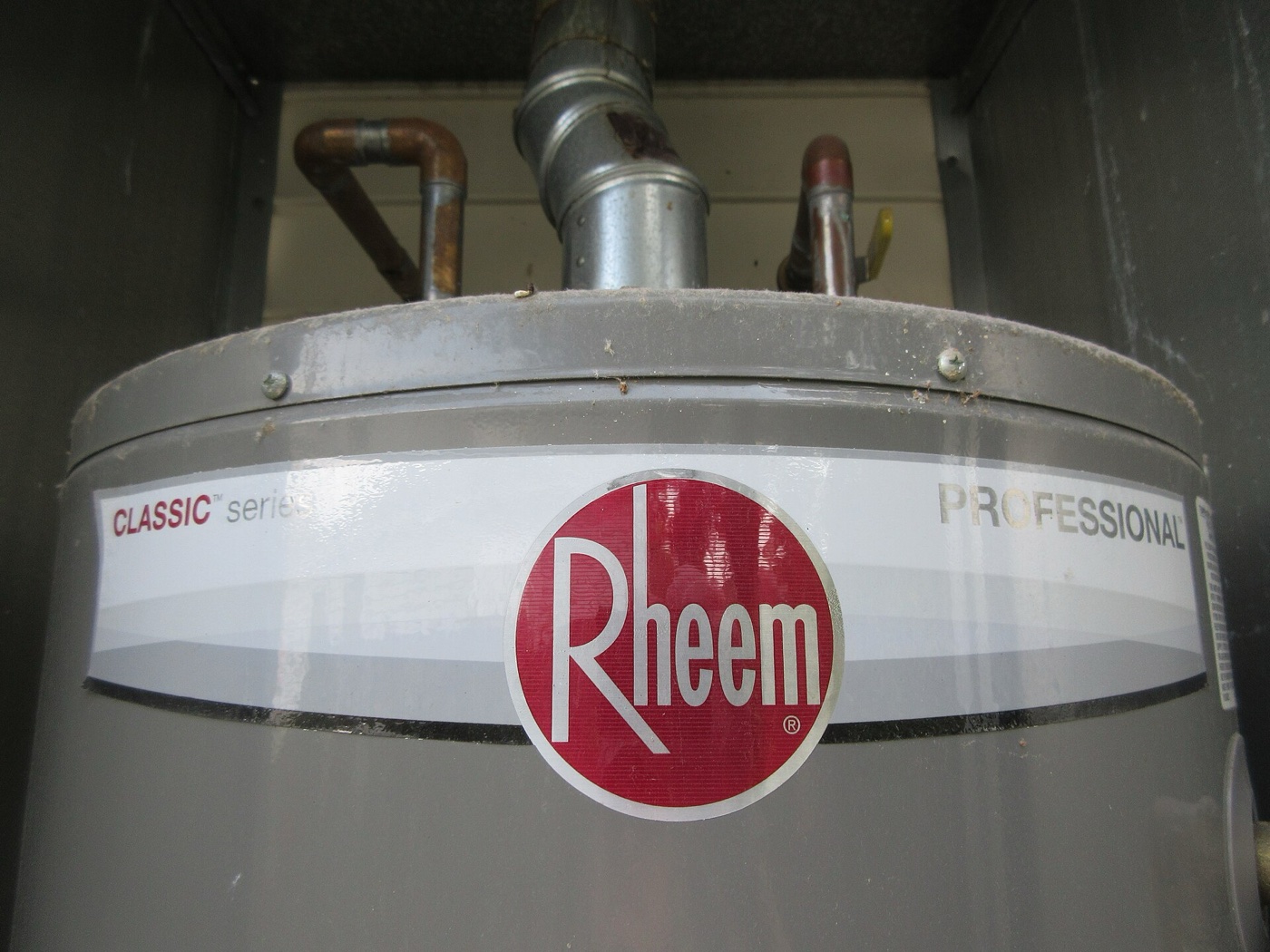
An atmospheric tank: the metal vent rises from the draft hood on top. If your heater looks like this and the vent is sound, an atmospheric replacement is usually the simplest job.
Top of a gas water heater with vent and water connectionsPhoto: Infrogmation of New Orleans ↗ · CC BY-SA 4.0 ↗Standard or high efficiency: what you actually get
Efficiency is rated as Uniform Energy Factor (UEF), which DOE adopted in 2017 in place of the older Energy Factor. Compare UEFs only between heaters of the same fuel and the same usage bin (very small, low, medium or high); ENERGY STAR says most conventional heaters fall between 0.63 and 0.95. Find it on the yellow EnergyGuide label or the spec sheet; see how to read the EnergyGuide label.
Sources: ENERGY STAR residential water heater key product criteria and certified gas water heater dataset. ENERGY STAR certifies heat pump water heaters but no standard electric resistance tanks.
On October 4, 2026, ENERGY STAR’s certified list held 71 residential gas storage listings, and every one was a power vent or power direct vent model with a recovery efficiency of 91–97%. These are condensing designs, such as Rheem’s Performance Plus Maximus (with a built-in condensate neutralizer) and A.O. Smith’s Vertex HV. For comparison, Bradford White lists 78–79% recovery efficiency for its standard atmospheric and power direct vent tanks.
Is the upgrade worth it? DOE’s own analysis is a useful reality check. In the 2024 rule, DOE estimated the top condensing level would cost about $800 more installed and save some gas each year, but that over the heater’s life it would leave about 70% of households with a net cost (2022 dollars). DOE set the 2029 gas-tank minimum at a non-condensing level. A condensing tank tends to make most sense when you already need a new vent route, use a lot of hot water, or have a utility rebate; check rebates. The federal 25C tax credit ended for improvements made after December 31, 2025.
Tall, short and lowboy tanks hold about the same water
The same capacity often comes in several shapes. A tall tank is narrow, a short (or “medium”) tank is wider, and a lowboy is squat enough to fit under a low ceiling, a stair or a counter. Shape barely changes performance: Rheem’s tall and short 50-gallon electric tanks share a first-hour rating of 62 gallons.
| Shape | Model | Height × diameter | First-hour rating |
|---|---|---|---|
| Tall, 50 gallons | Rheem Performance Plus XE50T09EL45U1 | 58⅞ × 20¼ in. | 62 gallons |
| Short, 50 gallons | Rheem Performance Plus XE50M09EL45U1 | 48 × 23 in. | 62 gallons |
| Tall, 40 gallons | A.O. Smith ProLine ENT-40 | 61¼ × 18 in. | 53 gallons |
| Lowboy, 38 gallons | A.O. Smith ProLine ENLB-40 | 32 × 23 in. | 51 gallons |
| Tall gas, 50 gallons | A.O. Smith ProLine GUR-50 (atmospheric) | 57 × 22 in. | 84 gallons |
Sources: Rheem Performance Plus spec sheet (form THD-P+E9 N, 11/17); A.O. Smith product pages, checked October 4, 2026. Check the exact model: diameters vary by brand and series.
Federal rules: what changed in 2015 and what is set for 2029
2015. DOE’s standards under the National Appliance Energy Conservation Act (NAECA) took effect on April 16, 2015. Most tanks gained insulation and grew. Electric tanks over 55 gallons now need a UEF of about 2.0, which only heat pump models reach; A.O. Smith said at the time that “certain gas water heaters over 55 gallons” would need condensing technology. One exception remains: grid-enabled electric resistance tanks over 75 gallons, sold with an activation lock for utility demand-response programs.
2029. DOE’s May 2024 final rule sets new minimums for heaters made on or after May 6, 2029. Electric tanks of 20–55 gallons must reach a UEF of 2.30 and those of 55–120 gallons 2.50, levels that require heat pump technology. The exception is small electric tanks of 20–35 gallons rated in the two lowest-use bins, which keep a resistance-level standard. Gas tanks of 20–55 gallons get a modest increase; DOE modeled it with electronic ignition and an electric flue damper, and A.O. Smith says its atmospheric models “will require the addition of a damper.” Gas tanks over 55 gallons don’t change.
Expect 8–15 years, and read the warranty for what it leaves out
Estimates of tank life vary by source: 8–12 years (Rheem), 10–12 (ENERGY STAR), 10–15 (DOE Energy Saver). DOE’s 2024 rule modeled an average of 14.5 years for gas tanks and 15.1 for electric. Rheem names hard water, heavy use and skipped maintenance as the things that shorten it; see how long water heaters last.
- Warranty length tracks price tier. A.O. Smith’s ProLine tanks carry 6 years on tank and parts, its Vertex HV 8; Rheem’s Performance Plus spec sheet lists 9 years plus 2 years of in-home labor; Bradford White sells 6- and 10-year versions of the same tanks.
- Labor is often excluded. A.O. Smith’s residential warranty puts labor, removal and related charges on the owner unless state law says otherwise, and its labor terms, where offered, run 1–3 years.
- Transfer rules differ. Bradford White’s warranty extends to later owners while the heater stays where it was installed; many others cover the original owner only.
- Installation counts. A.O. Smith’s warranty excludes heaters not installed to local code or the manufacturer’s instructions, and those in a closed system without provision for thermal expansion; see expansion tanks.
Read the certificate for your exact model before you count on it. Water heater warranties covers what voids coverage and how claims work.
When a tank is the right choice
A gas tank fits when
Good
- You have gas and a sound vent that a same-type model can reuse
- You want the fastest recovery for the money
- Several people shower in the same hour
Watch for
- Changing the vent type adds cost
- Standard models rate only about 0.60–0.73 UEF
Best for: Replacing an existing gas tank on a budget or in a hurry.
An electric tank fits when
Good
- There is no gas, or no practical way to vent
- The space is a small closet or a low spot that suits a lowboy
- Your household is small or spreads its showers out
Watch for
- Slower recovery than gas
- A heat pump tank does the same job on a fraction of the power
Best for: Small households and spaces where a heat pump won’t fit.
Look past a standard tank when
Good
- A heat pump tank fits the space and your climate
- You need endless hot water and can supply the gas or power a tankless unit needs
Watch for
- Higher price and more installation work
Best for: Compare all three in tank vs. tankless vs. heat pump.
Switching fuel is a bigger project than either swap; see gas vs. electric. Whatever you choose, ask each installer for the model number, its first-hour rating and how it vents, and compare quotes on those.
Common questions
What is the difference between an atmospheric and a power vent water heater?
An atmospheric gas tank lets hot exhaust rise on its own through a metal vent to a chimney or the roof, and needs no electricity. A power vent tank uses a blower to push exhaust out, usually sideways through a wall, and needs a 120-volt outlet. Power vents cost more but can go where there is no chimney.
Can I replace an atmospheric water heater with a power vent model?
Usually, yes, but it is a bigger job: a new vent through a wall, an outlet, and sometimes work on a furnace that shared the old vent. Ask the installer to include all of that in the quote. If the existing vent is sound, another atmospheric tank is normally the simpler swap.
Do power vent water heaters work during a power outage?
No. The blower and controls need electricity, so the burner won’t run until power returns, though the tank still holds whatever hot water was in it. Atmospheric tanks with a standing pilot and a thermopile-powered gas valve, such as Bradford White’s, need no outside electricity and keep heating.
Why does my electric water heater take so long to recover?
Standard electric tanks heat with one element at a time. A 4,500-watt element reheats about 21 gallons per hour at a 90°F rise, roughly half the rate of a typical gas burner. If you run out often, the cause may be a failed element or thermostat, or a tank too small for your busiest hour.
Are electric tank water heaters being banned?
Not banned. Under DOE’s 2024 rule, most electric tanks of 20–55 gallons made from May 6, 2029 must meet an efficiency only heat pumps reach; small low-use tanks of 20–35 gallons are exempt. Electric tanks over 55 gallons have had to meet heat-pump-level efficiency since 2015. As of October 4, 2026, the 2029 rule has not been withdrawn.
What is a lowboy water heater?
A short, wide tank for spaces with little headroom. A.O. Smith’s 38-gallon ProLine lowboy is 32 inches tall and 23 inches across, with a first-hour rating of 51 gallons.
Is a high-efficiency gas tank worth it?
It depends on the job. ENERGY STAR gas tanks are condensing models that cost more and need plastic venting, power and a condensate drain. DOE estimated they leave most households with a net cost over the heater’s life, so they make most sense with a rebate, high hot water use or a vent that has to change anyway.
Sources
Sources checked October 4, 2026. Prices, codes and rebates change. Check current details with your installer and local permit office.
- Consumer Water Heaters: standards rulemaking status ↗ · U.S. Department of Energy, Building Technologies Office
- Energy Conservation Standards for Consumer Water Heaters, final rule (89 FR 37778) ↗ · U.S. Department of Energy, Federal Register via govinfo
- 10 CFR 430.32(d): energy conservation standards for water heaters ↗ · Electronic Code of Federal Regulations
- 10 CFR 430.2: definitions (grid-enabled water heater) ↗ · Electronic Code of Federal Regulations
- DOE Residential Regulations for Water Heaters ↗ · A.O. Smith
- Industry prepares for new residential water heater standards (2015) ↗ · ACHR News
- NAECA 2015 builder brochure ↗ · State Water Heaters, hosted by Brothers Plumbing
- Residential water heaters key product criteria ↗ · ENERGY STAR
- ENERGY STAR Certified Gas (Storage and Tankless) Water Heaters dataset ↗ · ENERGY STAR
- What is Uniform Energy Factor and why does it matter? ↗ · ENERGY STAR
- What goes into the cost of installing a heat pump water heater? (tank lifespan) ↗ · ENERGY STAR
- Tankless or Demand-Type Water Heaters (archived copy, June 2026; storage heater lifespan) ↗ · U.S. Department of Energy, Energy Saver
- Gas water heater types explained: atmospheric, power vent, direct vent and more ↗ · Rheem
- The top installation mistakes plumbers see with water heaters ↗ · Rheem
- Water heater lifespan: when to repair vs. replace ↗ · Rheem
- Technical service bulletin: how an electric thermostat works ↗ · Rheem
- Performance Plus electric water heater spec sheet (form THD-P+E9 N) ↗ · Rheem, hosted by Home Depot
- Performance Plus Maximus XG50T09UHN50U0 product page ↗ · Rheem
- EcoSense condensing power direct vent spec sheet ↗ · Rheem, hosted by Home Depot
- ProLine GUR-50 atmospheric vent gas water heater ↗ · A.O. Smith
- ProLine XE GPVL-50 power vent gas water heater ↗ · A.O. Smith
- ProLine GDV-40 direct vent gas water heater ↗ · A.O. Smith
- ProLine XE GPDX-50L power direct vent gas water heater ↗ · A.O. Smith
- Vertex HV HPCX-50L condensing gas water heater ↗ · A.O. Smith
- ProLine ENT-40 tall electric water heater ↗ · A.O. Smith
- ProLine ENLB-40 lowboy electric water heater ↗ · A.O. Smith
- Residential atmospheric vent gas water heaters spec sheet (RG250T6N) ↗ · Bradford White, hosted by Young Supply
- Residential power direct vent gas water heater spec sheet ↗ · Bradford White, hosted by SupplyHouse
- Warranty Center FAQ ↗ · Bradford White
- Residential water heater limited warranty (form 100286376, Lowe’s channel, 2018) ↗ · A.O. Smith
- Water heater buying guide (updated August 2026) ↗ · Consumer Reports
- Energy Efficient Home Improvement Credit ↗ · IRS
- Water heater installation cost guide (tank range used in Ember & Tank pricing data) ↗ · Home Depot