THE SHORT VERSION
- The vent’s job is to get carbon monoxide out of the house. A vent that’s blocked, disconnected, the wrong size or overpowered by exhaust fans can spill exhaust into the room. EPA lists back-drafting gas water heaters as a household CO source.
- Atmospheric tanks rely on hot exhaust rising through metal pipe or a chimney. Power vent, direct vent and condensing units use sealed plastic or stainless pipe, often through a wall, and the manual names exactly which pipe.
- Replacing a furnace can strand the water heater. A new condensing furnace leaves through its own plastic pipe, and the water heater may be left alone in a chimney too big and cold to draft. Codes then require resizing or relining. DOE’s furnace rule priced this fix at $806 on average (2022 dollars).
- Where the pipe ends outside is regulated. Under the International Fuel Gas Code, a power vent must end at least 4 feet below or beside an openable window or door, or 1 foot above it, and 12 inches above grade. Manufacturers also ask for 12 inches above expected snow.
- Warning signs: melted plastic rings or soot on top of the tank, a sagging or disconnected vent pipe, and any CO alarm. Get everyone outside first, then call for service.
Five ways a gas water heater vents, side by side
Look at the top of your heater. A metal pipe rising from a cone-shaped draft hood, with an open gap above the tank, means atmospheric (natural draft). Plastic pipe leaving a fan housing means power vent. Two pipes, or a pipe inside a pipe, to an outside wall means direct vent or power direct vent. Plastic pipe plus a small drain tube means condensing.
| Vent type | Power needed | Pipe material | Maximum run (example model) | Typical when |
|---|---|---|---|---|
| Atmospheric tank | None | Type B double-wall vent, single-wall metal connector or a lined chimney | Sized from code tables; a single-wall connector’s horizontal run is limited to 75% of the vent’s height | A sound existing vent and a same-type swap |
| Direct vent tank (no fan) | None | The maker’s concentric wall kit | Up to 80 in. from the outside wall (A.O. Smith GDV-40) | The tank can sit against an outside wall; no chimney, no outlet |
| Power vent tank | 120 V | PVC, CPVC, ABS or polypropylene, as the manual lists | 2 in.: 50 ft; 3 in.: 125 ft equivalent (A.O. Smith power vent, 40,000–50,000 Btu/h) | No usable chimney, or the heater sits far from a wall |
| Power direct vent tank | 120 V | PVC, ABS or CPVC; separate intake and exhaust pipes | 3 in.: 85 ft for each pipe (Bradford White URG2PDV50S6N) | Tight houses, closed rooms, long routes |
| Condensing tank | 120 V plus a drain | Schedule 40 PVC, CPVC, ABS or polypropylene | 3 in.: 150 ft for each pipe (A.O. Smith condensing, two-pipe) | High efficiency, or the vent has to change anyway |
| Non-condensing tankless | 120 V | Category III stainless steel | Per the manual (Rinnai RE199i uses a 3 in./5 in. concentric system) | Replacing a non-condensing tankless with the same type |
| Condensing tankless | 120 V plus a drain | PVC, CPVC or polypropylene (Rinnai bars ABS for exhaust) | 2 in.: 65 ft; 3 in.: 150 ft (Rinnai RU199i). Navien NPE-2: 2 in. PVC to 75 ft | Tank-to-tankless conversions with a wall or roof nearby |
Sources: A.O. Smith manuals and GDV-40 page; Bradford White, Rinnai, Navien and Noritz spec sheets and manuals. “Equivalent feet” count each elbow as extra pipe. Limits vary by model, burner size and altitude; the manual for the exact unit rules.
Costs and trade-offs of each heater type are in tank water heaters and tankless water heaters. This guide covers the vent itself.
Categories I–IV: pressure and condensation decide the pipe
Manuals sort gas appliances into four vent categories, defined in the International Fuel Gas Code (IFGC), the model gas code many states adopt. Two questions decide them: is the vent under negative pressure (drawn up by draft) or positive pressure (pushed by a fan, so a leak blows exhaust out)? And does the exhaust condense inside the pipe?
| Category | Vent pressure | Condenses in the vent? | Water heater examples | Vent pipe |
|---|---|---|---|---|
| I | Negative (natural draft) | No | Atmospheric tanks (A.O. Smith certifies its atmospheric tanks as Category I) | Type B double-wall vent, single-wall connector, lined chimney |
| II | Negative | Yes | Uncommon in water heaters | As the manufacturer specifies |
| III | Positive | No | Non-condensing tankless (Noritz: “Category 3 stainless steel”) | Sealed stainless steel vent listed for the appliance |
| IV | Positive | Yes | Condensing tanks and tankless; some power vent tanks (A.O. Smith’s is certified Category IV) | PVC, CPVC, ABS or polypropylene, as the manual names |
Sources: IFGC section 202 (2021 edition as published by the City of Seattle); A.O. Smith manuals; Noritz. Plastic is allowed only where the appliance is listed for it and its manual names the plastic (IFGC 503.4.1).
Two rules follow. A natural-draft vent can’t be tied into a positive-pressure vent, because the fan would push exhaust out of the draft hood (IFGC 503.3.3, 503.10.4). And plastic pipe isn’t generic: A.O. Smith and Rinnai both ban foam-core PVC, and they disagree about ABS. A.O. Smith accepts it; Rinnai doesn’t allow it for exhaust.
Atmospheric venting: the draft hood, the connector and the chimney
An atmospheric tank sends exhaust up a flue through the middle of the tank to the draft hood, which mixes in room air through an open gap. The code defines its purpose: let flue gases escape if the vent stops drawing, keep a backdraft from reaching the burner, and even out the chimney’s pull. That gap is also exactly where exhaust spills when something is wrong.
What inspectors check (2021 IFGC as published by Seattle; city checklists from Golden Valley, Minnesota and Hayward, California):
- Slope: the connector rises at least 1/4 inch per foot toward the vent, with no dips (IFGC 503.10.8).
- Length: a single-wall connector’s horizontal run is at most 75% of the vent’s height; Type B double-wall, 100% (503.10.9).
- Height: a Type B vent ends at least 5 feet above the draft hood, with a listed cap (503.6.6).
- Clearance: 6 inches from single-wall pipe to combustibles; 1 inch for Type B, per both city checklists.
- Joints: three sheet-metal screws per single-wall joint, no tape (Hayward), and no screws through a Type B vent’s inner wall.
- Size: never smaller than the draft hood outlet (504.3.21). A.O. Smith says to use the new draft hood shipped with the heater.
A.O. Smith also bars single-wall pipe from attics and crawl spaces. Before connecting to a chimney, code requires it to be inspected, cleaned if it once served wood, coal or oil (503.5.6), and lined to NFPA 211 (503.5.6.1).
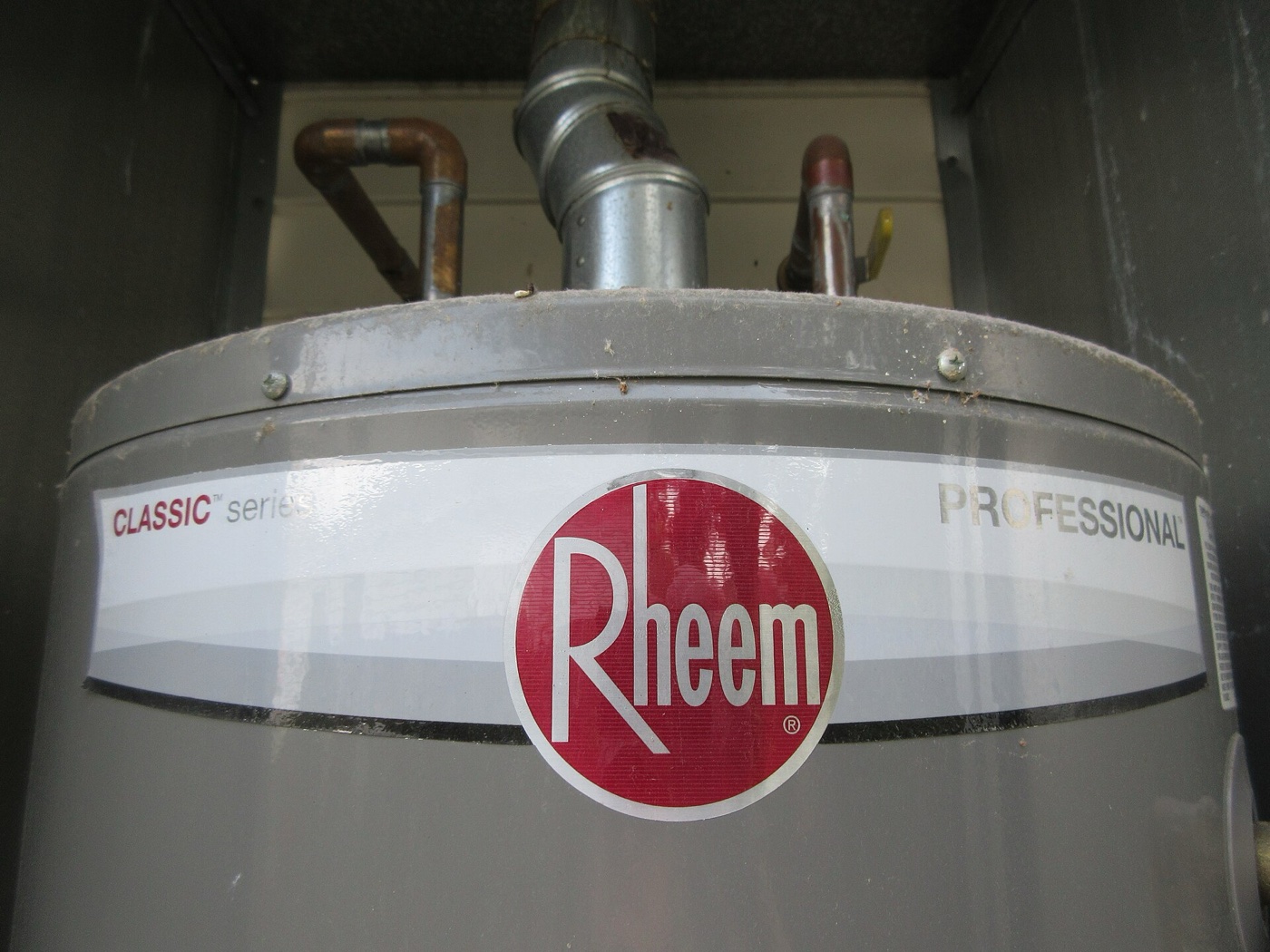
An atmospheric tank: the metal vent rises from the draft hood. The connector should climb steadily toward the chimney or vent, never level or downhill.
Top of a gas water heater with vent and water connectionsPhoto: Infrogmation of New Orleans ↗ · CC BY-SA 4.0 ↗The orphaned water heater: when the furnace leaves the chimney
In many older homes the furnace and water heater share a chimney or B-vent. Replace the furnace with a condensing model and it gets its own plastic vent, because codes don’t allow condensing and non-condensing appliances on one vent. The water heater is left alone in a flue sized for two. DOE calls it an orphaned water heater.
A small burner can’t keep a big, cold flue warm. Draft weakens, exhaust can spill at the draft hood, and water vapor condenses inside. This Old House’s Richard Trethewey notes that as appliances grew more efficient and exhaust cooler, unlined chimneys began deteriorating from that condensation.
When an appliance is permanently disconnected from a shared chimney or vent, the IFGC requires resizing as needed to control condensation and give the remaining appliance enough draft (501.15). For a lone water heater the limits bite:
- Not too big: a single natural-draft appliance’s vent may not exceed seven times its draft hood outlet area (504.2.8). A 3-inch outlet is about 7.1 square inches, so the cap is about 49.5; a common 8 × 12-inch clay flue tile counts as 63.6 in the code appendix.
- Outside walls are worse: a lone water heater may use the table for a clay-tile-lined exterior masonry chimney only if, among other conditions, the local winter design temperature is 5°F or warmer (504.2.9).
- The code’s own example fails: the IFGC appendix puts a 35,000 Btu/h water heater and a 100,000 Btu/h furnace in an exterior chimney in Charlotte, North Carolina. Even with both connected, the furnace is below the chimney’s minimum input, so the example relines it with a 5-inch metal liner.
Line the chimney
A listed liner sized for the water heater. The space around it can’t vent anything else (503.5.10).
Run a new Type B vent
Where there’s a route to the roof.
Change the water heater
DOE notes a power-vented or tankless heater avoids the chimney work; an electric or heat pump water heater needs no vent.
Power vent and direct vent: fans, plastic pipe and equivalent feet
A power vent tank has a blower on top that pushes exhaust through sealed plastic pipe, usually out a side wall. The code requires gas to shut off if the fan isn’t moving enough air (503.3.3). A.O. Smith says some installs condense water in the pipe, so it slopes back toward the heater.
Each manual sets its own pipe rules, and they don’t match:
| Rule | A.O. Smith power vent (Series 200) | Rheem Performance power vent |
|---|---|---|
| Pipe allowed | PVC, CPVC, ABS or polypropylene | PVC, ABS or CPVC |
| Longest 2-inch run | 50 equivalent ft | 55 equivalent ft (below 2,000 ft elevation) |
| Longest 3-inch run | 125 equivalent ft (minimum 50) | 150 equivalent ft |
| One 90° elbow counts as | 8 ft short-radius, 5 ft long-radius; five 90° elbows at most | About 5 ft |
| Hot rooms | 110–140°F needs CPVC or polypropylene | 100–175°F kit; first 10 ft must be CPVC or ABS |
Sources: A.O. Smith power vent manual 100366731 Rev. A (February 2023); Rheem spec sheet THD-PGPV N Rev. 9 (03/21). Above 2,000 ft elevation Rheem cuts the 2-inch maximum to 25–40 ft.
Worked example (hypothetical): a 40,000 Btu/h A.O. Smith power vent needs 20 feet of pipe and four 90° turns. With short-radius elbows that is 20 + (4 × 8) = 52 equivalent feet, over the 2-inch limit of 50. With long-radius elbows it is 20 + (4 × 5) = 40, which fits. Ask the installer to show this arithmetic for your route.
Direct vent and power direct vent
A direct vent heater takes all its combustion air from outdoors and sends all exhaust outdoors, so it doesn’t compete with exhaust fans for room air. Without a fan the run is short: A.O. Smith’s GDV-40 vents up to 80 inches from the outside wall. A power direct vent adds a blower; Bradford White lists 85 feet each for intake and exhaust on 3-inch pipe for two models.
Condensing tanks and tankless units: plastic pipe plus a drain
A condensing heater pulls so much heat from the exhaust that water vapor turns to liquid. The exhaust is cool enough for plastic, but the IFGC requires that condensate to be collected and disposed of (503.9). A.O. Smith says its condensing tanks make condensate that is “mildly acidic (pH levels between 4.3 and 5.0)”, and some local codes require a neutralizer, a cartridge that raises the pH before the drain.
- Slope back to the heater: 1/4 inch per foot, so condensate runs to the built-in trap (A.O. Smith).
- A clogged drain shuts it down: water backs up and trips a “Blocked Exhaust” fault; A.O. Smith says check the drain first.
- Not into an old chimney: Rinnai says not to connect its condensing units to an existing vent or chimney, and that an existing Category I vent “may not be suitable”. Where a manual allows, approved pipe may run up an unused flue as a chase (503.5.10).
Tankless: stainless or plastic depends on condensing
Non-condensing tankless units are Category III: Noritz says they need Category III stainless steel, and Rinnai’s RE series uses its own 3-inch/5-inch concentric system. Condensing units are Category IV and use plastic: PVC, CPVC or polypropylene for Rinnai, those plus stainless for Navien. Either way it’s new pipe, never the tank’s old vent. More in tankless water heaters.
Where the vent can end outside
Where the pipe exits the house, the termination, is regulated so exhaust can’t drift back in through a window, door or air intake. Fan-driven vents that use room air need more distance than sealed direct-vent units.
| Clearance to | Power vent (uses room air) | Direct vent (sealed) |
|---|---|---|
| Openable window or door | 4 ft below or beside, or 1 ft above | 6 in. up to 10,000 Btu/h; 9 in. up to 50,000; 12 in. up to 150,000; above 150,000, per the manual but not less than the power vent distance |
| Finished grade, deck or porch | 12 in. above | 12 in. above |
| Mechanical air intake (for example an HRV or fresh-air duct) | 10 ft away horizontally, or 3 ft above | 10 ft away horizontally, or 3 ft above |
| Gas meter regulator vent | 3 ft (gas up to 2 psi) | 3 ft (gas up to 2 psi) |
| Public sidewalk or driveway | 7 ft above; condensing vents not over walkways | 7 ft above; condensing vents not over walkways |
Source: IFGC 503.8 and Table 503.8, 2021 edition as published by Seattle; the same distances appear in the 2018 edition. States amend these codes, and California uses a different code family. The local permit office has the final word.
A.O. Smith and Rinnai both want the termination 12 inches above ground or expected snow. Rinnai says to avoid dryer vents and air inlets, and warns exhaust moisture under eaves can stain siding.
Sharing a vent with a furnace: when it’s allowed
A draft-hood water heater may share a vent with a Category I furnace if the vent is sized for both. The IFGC appendix example: a 35,000 Btu/h water heater and a 100,000 Btu/h fan-assisted furnace on a 30-foot Type B vent need 4-inch connectors and a 5-inch common vent; a 4-inch vent, rated 132,000 Btu/h, falls short of the 135,000 combined.
- The smaller appliance enters higher on the common vent (503.10.4).
- Only Category I with Category I: never a power vent or condensing appliance.
- Change one, recheck both: a new appliance changes the combined input, so the vent must be re-sized from the tables.
Signs a vent isn’t working
Carbon monoxide is odorless and colorless (EPA). CPSC says early poisoning feels like flu without fever: headache, fatigue, shortness of breath, nausea, dizziness. Its 2022 annual estimates put US deaths from carbon monoxide from consumer products, water heaters among them, at an average of 238 a year for 2020–2022. A homeowner guide from the Pacific Northwest National Laboratory (PNNL), written for DOE, lists what to look for:
Look, don’t touch
- Melted plastic rings around the pipes on top of the tank, or soot on the tank top. PNNL says they mean the heater has backdrafted, now or in the past.
- A vent connector that is disconnected or slopes down toward the chimney.
- Any CO alarm that has sounded, even once.
- On condensing units, a “Blocked Exhaust” fault, or snow over the outside termination.
PNNL also describes a draft check. After a shower, while the burner runs, hold a smoking incense stick near the draft hood gap (PNNL also mentions a lighter flame; smoke is the safer choice, and never do this if you smell gas). Smoke pulled in means it’s drafting; pushed away means it’s spilling, so call a plumber. Don’t touch the vent, which A.O. Smith warns can burn. The installer’s fuller test, printed in gas appliance manuals such as Williams Furnace’s, closes doors and windows, runs the dryer and every exhaust fan at full speed, and checks for spillage after 5 minutes.
What a venting change costs
A same-type atmospheric swap on a sound vent needs little vent work. Changing vent type or fixing an orphaned chimney is where costs grow. No national dataset tracks vent work alone; these are the published figures:
| Work | Figure | Whose number |
|---|---|---|
| Basic gas venting (tank) | $300–$500 | This Old House |
| Power venting | $300–$600, plus $300–$500 for electrical | This Old House |
| Direct venting | $500–$1,000 | This Old House |
| Tankless venting | $500–$1,000 | This Old House |
| New chimney liner | $500–$700 | This Old House |
| Fixing an orphaned water heater after a condensing furnace install | $806 average; needed in 7% of DOE’s modeled condensing-furnace replacements | DOE furnace rule, 2022 dollars |
| Updating a vent connector at a non-condensing furnace swap | $328 average, in 23% of replacements | DOE furnace rule, 2022 dollars |
Sources: This Old House, “How much does water heater installation cost?” (updated June 17, 2026); DOE final rule for consumer furnaces, 88 FR 87502 (December 18, 2023), Table IV.8. These are add-ons to the heater and its installation; Home Depot publishes $1,600–$2,400 installed for a standard tank.
Real causes hide in those ranges: roof versus wall routes, ceilings to open and patch, a missing outlet, a condensate pump. Ask for vent work as its own line item; see what makes one installation cost more and how to compare quotes.
What to ask the installer about venting
Venting questions for every quote
- Will the new heater vent the same way as the old one? If not, what pipe, what route and where does it end outside?
- What is the equivalent length of the vent run, and how does it compare with the manual’s limit for that pipe size?
- Does the heater share a vent or chimney with the furnace or a boiler, and is any resizing or relining included?
- Is the chimney lined, and has the liner been inspected?
- For power vent or condensing models: where is the outlet, where does the condensate drain, and is a neutralizer included?
- Will you test the draft (or check the vent) with exhaust fans and the dryer running before you leave?
- Is the permit included? Venting is part of what the inspector checks; see permits and inspections.
Venting isn’t homeowner work: every detail depends on the manual and on tables keyed to height, input and climate, and a mistake fails silently. Switching fuel removes the vent entirely; see switching from gas to electric.
Common questions
What is an orphaned water heater?
A gas water heater left alone in a chimney or vent it used to share with a furnace, usually after a condensing furnace gets its own plastic vent. The flue is now too big and cold for the water heater, so draft suffers and condensation forms. Codes require resizing or relining.
Do I need a chimney liner for my water heater?
If it vents into a masonry chimney, the IFGC requires the chimney to be lined to NFPA 211 and sized for what it serves. A lone water heater in an oversized or exterior chimney often needs its own liner. This Old House puts a new liner at $500–$700.
Can a gas water heater be vented with PVC?
Only if the heater is listed for it and its manual names the pipe. Power vent, power direct vent and condensing models use PVC, CPVC, ABS or polypropylene, depending on the brand. Atmospheric tanks need metal Type B vent, single-wall connector or a lined chimney, never plastic.
How far from a window does a water heater vent have to be?
Under the IFGC, a power vent using room air must end 4 feet below or beside an openable window or door, or 1 foot above it. A sealed direct-vent unit needs 6–12 inches depending on its input, and more above 150,000 Btu/h. Local codes can differ.
How do I know if my water heater is backdrafting?
Look for melted plastic rings or soot on the tank top and a disconnected or downhill vent pipe. With the burner running, incense smoke at the draft hood gap should be pulled in (skip this if you smell gas). If it’s pushed out, or a CO alarm sounds, get out and call for help.
Why is water dripping from my water heater vent?
On a condensing or power vent unit, some water in the vent can be normal, and it should drain to the heater’s trap. On an atmospheric tank, dripping can mean exhaust is condensing in a vent that is too large or too cold, which is a draft problem. Have a plumber check it.
Sources
Sources checked October 4, 2026. Prices, codes and rebates change. Check current details with your installer and local permit office.
- Non-fire carbon monoxide deaths associated with the use of consumer products, 2022 annual estimates ↗ · U.S. Consumer Product Safety Commission
- 2021 Seattle Fuel Gas Code, Chapter 5: Chimneys and vents (IFGC with local amendments) ↗ · City of Seattle
- 2018 Seattle Fuel Gas Code, Chapter 5 (section 503.8 termination locations) ↗ · City of Seattle
- 2021 Seattle Fuel Gas Code, Chapter 2: Definitions (vented appliance categories, draft hood, direct vent) ↗ · City of Seattle
- 2021 Seattle Fuel Gas Code, Appendix B: Sizing of Category I venting systems (worked examples) ↗ · City of Seattle
- Ultra-low NOx atmospheric gas water heater installation manual (100263190) ↗ · A.O. Smith
- Power vented gas water heater installation and operating manual, Series 200/201 (100366731 Rev. A) ↗ · A.O. Smith
- Condensing gas water heater installation and operating manual, Series 100 ↗ · A.O. Smith, hosted by Lowe’s
- ProLine GDV-40 direct vent gas water heater ↗ · A.O. Smith
- Performance power vent gas water heater spec sheet (THD-PGPV N Rev. 9) ↗ · Rheem, hosted by Home Depot
- Residential power direct vent gas water heater spec sheet ↗ · Bradford White, hosted by SupplyHouse
- CX/CXP condensing tankless installation and operation manual ↗ · Rinnai, hosted by Lowe’s
- RU series condensing indoor tankless specification sheet ↗ · Rinnai
- RE series non-condensing indoor tankless specification sheet ↗ · Rinnai
- NPE-2 series specification sheet ↗ · Navien
- NPE-210A2 features (vent materials) ↗ · Navien
- Questions about tankless water heaters (venting materials) ↗ · Noritz
- Carbon monoxide’s impact on indoor air quality ↗ · U.S. EPA
- Carbon monoxide questions and answers ↗ · U.S. Consumer Product Safety Commission
- Look for signs of gas water heater backdrafting (updated July 2025) ↗ · Pacific Northwest National Laboratory, Building America Solution Center (DOE)
- Monterey top vent gas wall furnace installation manual (common-vent spillage test procedure) ↗ · Williams Furnace Co., hosted by Lowe’s
- Water heater replacement inspection handout ↗ · City of Golden Valley, Minnesota
- Residential water heater replacement checklist (revised 2021) ↗ · City of Hayward, California
- How much does water heater installation cost? (updated June 2026) ↗ · This Old House
- Energy conservation standards for consumer furnaces, final rule (88 FR 87502) ↗ · U.S. Department of Energy, via Federal Register
- Energy conservation standards for consumer water heaters, final rule (89 FR 37778) ↗ · U.S. Department of Energy, via Federal Register
- Water heater installation cost guide (tank range used in Ember & Tank pricing data) ↗ · The Home Depot