THE SHORT VERSION
- What you get: hot water that doesn’t run out at a steady flow, a small wall-hung cabinet, and lower energy use. DOE estimates tankless units are 24–34% more efficient than a storage tank in homes using up to 41 gallons a day, 8–14% in heavy-use homes.
- What it costs: $2,400–$5,400 installed, against $1,600–$2,400 for a tank (Home Depot’s national ranges). Conversions often need new venting and a bigger gas line.
- What it needs: gas for up to 199,000 BTU/h (five times a typical 40,000 BTU/h tank burner), plastic or stainless venting, a condensate drain on condensing models and a 120-volt outlet. Whole-house electric units draw up to 150 amps.
- What annoys owners: brief cold bursts between uses, nothing below a minimum flow, no hot water in a power outage, and yearly descaling in many homes.
- Good fit: gas homes with workable gas and vent routes and a long horizon. Poor fit: whole-house electric in cold-water regions, small panels, and anyone expecting a quick payback.
The honest verdict: tankless suits some homes, not all
A tankless (on-demand) water heater heats water as it passes through, so there is no stored hot water to run out of and no tank losing heat all day. The catch is physics: heating cold water to hot in seconds takes a very large burner or electrical circuit, and the heater only fires while enough water flows.
Sources: Home Depot cost guide (national installed ranges); DOE Energy Saver, “Tankless or Demand-Type Water Heaters” (archived); Rinnai, Navien and Rheem specifications.
Gas tankless
Good
- Continuous hot water up to its rated flow
- Lower gas use, mostly from no standby loss
- Longer expected life than a tank
- Frees floor space
Watch for
- Higher installed price
- Often needs a bigger gas line and new venting
- Needs power: no hot water in an outage
- Yearly descaling in hard water
Best for: Gas homes keeping the house 10+ years, with a workable vent route and gas supply.
Electric tankless
Good
- No venting or gas line
- Very small; good at a single remote sink
- No standby loss
Watch for
- Whole-house models need 75–150 amps
- Struggles with cold winter water
- Saves far less than a heat pump water heater
Best for: Point-of-use jobs and warm-climate homes with spare electrical capacity.
How a tankless heater makes hot water
Water starts flowing
You open a hot tap. A flow sensor on the cold inlet measures the flow. Nothing happens until it passes the minimum activation flow: 0.4 gpm for Rinnai’s current gas models, 0.5 gpm for Navien’s NPE-2 series and about 0.3 gpm for Rheem’s electric units.
The burner lights
The combustion fan starts and the electronic igniter lights the burner. Rinnai’s technical bulletin says this can take up to 10 seconds, and unheated water passes through in the meantime.
The burner modulates
The control board reads flow and incoming and outgoing temperatures and adjusts the gas valve to hold your setting. Rinnai’s RU199i fires anywhere from 15,000 to 199,000 BTU/h, a range of about 13 to 1; Navien quotes a turndown of up to 15 to 1.
Flow stops, burner stops
When you close the tap the burner shuts off. Only the small amount of water inside the unit and the pipes stays warm.
- Minimum activation flow
- The flow needed to fire the burner. Below it you get cold water, which is why a trickle from a single-handle faucet sometimes runs cold. Rinnai units keep running down to 0.26 gpm once lit.
- Turndown (modulation) ratio
- Maximum firing rate divided by minimum. A higher ratio lets the unit heat small flows, like a hand sink, without overshooting or cycling.
- UEF
- Uniform Energy Factor, DOE’s efficiency rating. For gas tankless units it runs from about 0.81 (non-condensing) to 0.96 (condensing). ENERGY STAR requires at least 0.95.
Condensing vs non-condensing: the efficiency and venting trade
A condensing tankless unit adds a second heat exchanger that pulls more heat out of the exhaust before it leaves. The exhaust cools so much that water vapor in it condenses, so the unit needs a drain for that acidic water. Because the exhaust is cool, it can vent through plastic pipe. A non-condensing unit has one heat exchanger, hotter exhaust and needs stainless steel venting.
| Non-condensing (RE199i) | Condensing (RU199i) | |
|---|---|---|
| Efficiency (UEF) | 0.82 | 0.93 |
| Heat exchangers | One | Two (primary and secondary) |
| Vent pipe | Manufacturer’s 3 in./5 in. concentric system | 2 in. or 3 in. Schedule 40 PVC/CPVC or polypropylene |
| Condensate drain | No drain connection listed | Required, 1/2 in. connection |
| Firing range | 10,400–199,000 BTU/h | 15,000–199,000 BTU/h |
| Heat exchanger warranty | 15 years or 12,000 operating hours | 15 years or 12,000 operating hours |
Sources: Rinnai RE and RU series indoor specification sheets. Noritz states that non-condensing units need Category III stainless steel venting and condensing units can use PVC, CPVC or polypropylene. Other brands differ; check the model’s manual.
Condensate must go somewhere legal. The 2024 International Fuel Gas Code (section 307.2) requires it to be collected and discharged to an approved fixture or disposal area per the manufacturer’s instructions, in corrosion-resistant pipe sloped at least 1/8 inch per foot. Rinnai sells a neutralizer that raises the condensate’s pH before it reaches the drain, and Rheem lists checking the neutralizer media as yearly maintenance. More on vent types in water heater venting.
Electric tankless needs a lot of amperage and still struggles in winter
Electric tankless units are simpler to install where a big circuit already exists: no gas, no vent, no condensate. The problem is power. Heating water fast takes enormous current, and output drops sharply as incoming water gets colder. Rheem’s published installation chart makes the trade-off plain:
| Size | Maximum draw | Breakers required | Rise at 3 gpm | Rise at 4 gpm |
|---|---|---|---|---|
| 18 kW | 75 A | 2 × 40 A | 41°F | 31°F |
| 27 kW | 112.5 A | 3 × 40 A | 61°F | 46°F |
| 36 kW | 150 A | 4 × 40 A | 82°F | 61°F |
Source: Rheem electric tankless installation instructions and home owners manual (sizing guide and electrical table). Each breaker needs its own run of wire, 8 AWG for these sizes.
Take DOE’s sizing example: 50°F water coming in and a 120°F setting, a 70°F rise. Northern winters are colder still. The 36 kW unit manages that at roughly 3.5 gpm, enough for one shower and a faucet. It also draws 150 amps, more than a whole 100-amp service and three-quarters of a 200-amp one. Only an electrician’s load calculation can say whether your panel and utility service can carry it.
Size by flow at your coldest water
A tankless heater is sized by gallons per minute at your winter temperature rise, not by household size. Add up the fixtures you run at the same time, subtract your coldest incoming water temperature from your setting, and read the model’s flow chart at that rise. The full method, with fixture flow tables, is in what size water heater you need.
- Rated flow is measured at a 67°F rise. That is the ENERGY STAR and DOE test condition. Navien lists its NPE-240A2 at 5.6 gpm for a 70°F rise, enough for two 2-gpm showers and a faucet.
- The largest residential models from Rinnai and Navien top out near 199,000 BTU/h. If that isn’t enough for your winter demand, installers link two units together.
- Big soaking tubs are where tankless disappoints: a tub fills no faster than the heater’s flow at your rise.
What installation really involves
Replacing a tank with a tankless unit is a conversion, not a swap. Rinnai’s manual expects the installer to handle gas sizing, venting, water and electrical connections and condensate disposal.
Gas line: sized on the whole house’s load
Codes size gas pipe on the total connected load of every appliance on the line and its length (2024 IRC G2413.2). A tankless burner is about five times a typical tank burner, so pipe that fed a tank for decades can be too small.
| Load on that pipe | 1/2 in. | 3/4 in. | 1 in. |
|---|---|---|---|
| 40,000 BTU/h gas tank alone | 100 ft | 100 ft+ | 100 ft+ |
| 199,000 BTU/h tankless alone | Too small at any length | 30 ft | 90 ft |
| Tankless plus a 65,000 BTU/h furnace | Too small | 10 ft | 50 ft |
Ember & Tank’s reading of the NFPA 54 capacity table reproduced in Rinnai’s installation manual (Table 24), assuming 1,000 BTU per cubic foot of gas. Equivalent lengths include fittings. Your installer must use the table in your locally adopted code.
Venting: new pipe, new route
Gas tankless units are fan-assisted and vent through pipe listed in their manual. Rinnai’s RU series allows 2-inch pipe up to 65 equivalent feet or 3-inch up to 150; Navien allows 2-inch PVC up to 75 feet. Rinnai does not permit ABS for exhaust, and an old tank’s draft-hood flue isn’t among the approved vent systems. Terminations need clearances from windows, doors and grade, so the shortest route isn’t always allowed.
Power, valves and clearances
- A 120-volt outlet near the unit. Rinnai’s condensing models draw at most 4 amps.
- Isolation valves with service ports on the hot and cold lines, so a pump can circulate descaling solution without cutting pipe. Rinnai calls them “not required, but highly recommended” and includes a kit with some models.
- A pressure relief valve, piped separately from the condensate drain.
- Service room: Rinnai asks for 24 inches in front and 12 inches below. A closet that fit a tank may not leave room to work.
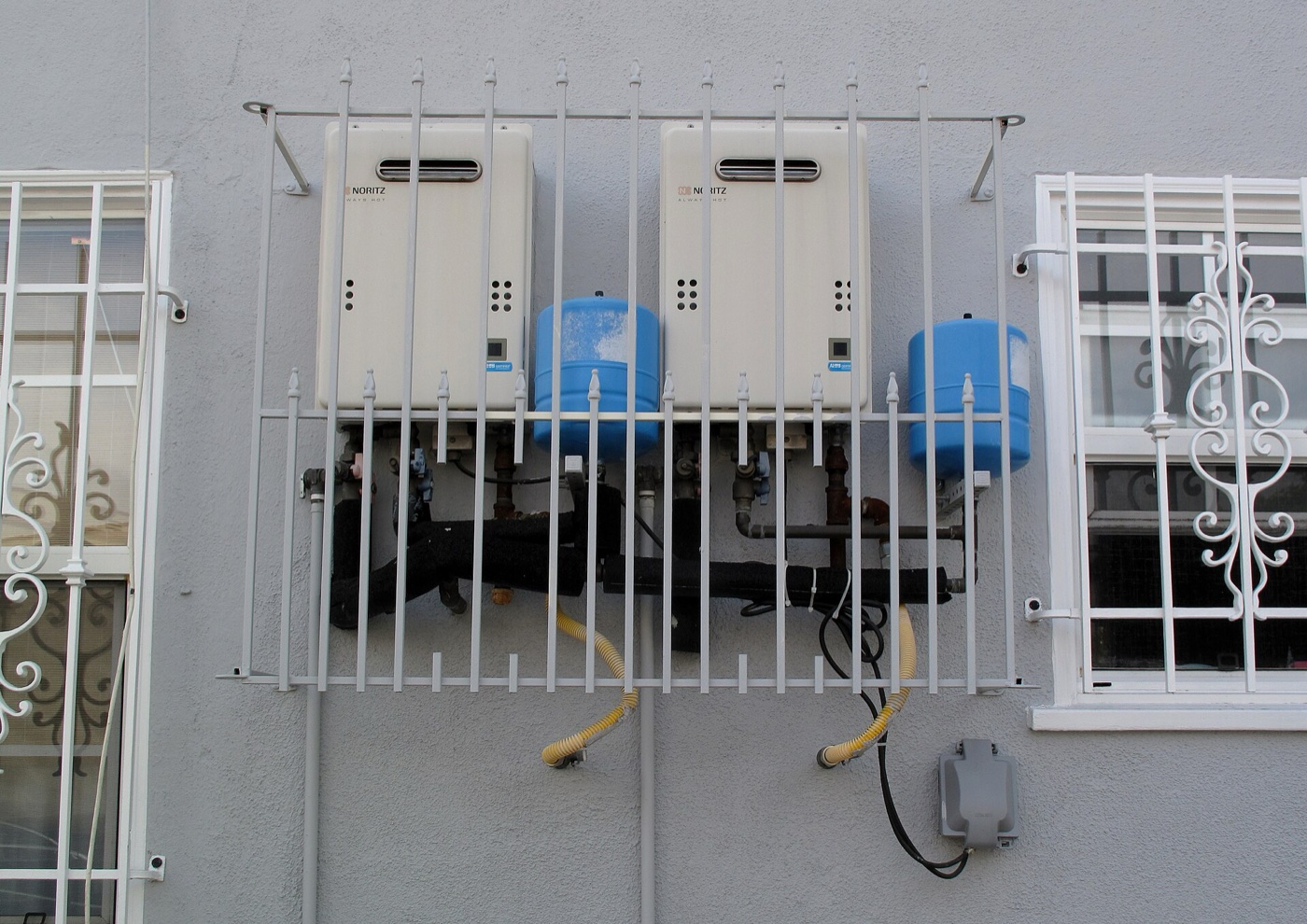
A wall-hung tankless unit. The valves and service ports below it are what make yearly descaling quick.
Wall-mounted gas tankless water heatersPhoto: Downtowngal ↗ · CC BY-SA 4.0 ↗The cold-water sandwich, the wait and recirculation
Tankless heaters don’t deliver hot water to the tap any faster. The water still has to travel down the pipe, and the burner needs a few seconds to light. They add one quirk of their own, the cold-water sandwich: shut the shower off for a minute, turn it back on, and you get a burst of hot, then a slug of cold, then hot again.
Rinnai describes the effect as present in all tankless heaters because safety standards require a delay before gas ignition. Manufacturers shrink it in three ways: keeping the unit ready to refire for a short time, a small built-in buffer tank (Navien’s NPE-A2 models have a 0.5-gallon one plus a pump), or a recirculation loop that keeps hot water near the fixtures.
Recirculation fixes both the wait and the sandwich, but it costs energy and can cost warranty. Rheem cuts its heat exchanger warranty from 15 years to 3 with an uncontrolled loop; Navien cuts it to 5. Controlled pumps keep standard coverage: Rheem’s terms call for a temperature sensor (aquastat) and timer, and Navien treats an aquastat as the minimum. Rinnai notes the most efficient setup is still tankless with no recirculation. See hot water recirculation pumps for the options.
Descaling is the price of admission in hard water
Minerals in hard water deposit as scale on the hottest surfaces, and in a tankless heater that is a narrow heat exchanger. Scale cuts output, triggers error codes (Rinnai’s is “LC”) and eventually damages the exchanger. Rheem’s gas tankless warranty excludes failures caused by “lime, mineral build-up, or scale.”
- How often: Rinnai says to flush at least once a year; Rheem recommends yearly service; Noritz recommends annual maintenance. Very hard water may need more.
- What it involves: with the gas off and the isolation valves closed, a small pump circulates descaler through the service ports. Rinnai’s procedure uses 4 gallons of undiluted white vinegar at about 4 gpm for at least an hour, then a rinse.
- Water limits: Rinnai’s manual caps total hardness at 200 mg/L. USGS classes anything over 180 mg/L as very hard, so a softener or scale filter is often part of the plan.
- The other yearly jobs: clean the inlet water filter, check the condensate neutralizer and look at the vent terminations for debris or snow.
Rinnai recommends a professional for flushing. Details are in descaling a tankless water heater, treatment options in hard water and your water heater, and error codes in tankless problems and error codes.
Lifespan and warranties: read the hours clause
DOE says most tankless heaters last more than 20 years, against 10–15 for tanks, partly because parts can be replaced. Makers are more cautious: Rinnai says up to 20 years and Noritz 10 to 25, both depending on water quality and maintenance.
| Line | Heat exchanger | Parts | Labor | Catches |
|---|---|---|---|---|
| Rinnai RU and RE (gas) | 15 years or 12,000 hours | 5 years | 1 year | Improper installation may void it |
| Navien NPE-2 (gas) | 15 years | 5 years | 1 year | 5-year heat exchanger with uncontrolled recirculation |
| Rheem residential gas | 15 years | 5 years | 1 year | Void after 12,000 hours; scale damage excluded; 3 years with uncontrolled recirculation |
| Rheem electric (Professional Classic) | 5 years (heating chamber) | 1 year | None stated | Rheem may deny claims for damage from water outside its quality limits |
Sources: Rinnai and Navien specification sheets, Rheem RTGH warranty guide, Rheem electric tankless spec sheet and manual. Terms change; read the certificate for your model.
The 12,000-hour limit is less alarming than it sounds for most homes. Say the burner runs 2 hours a day: 12,000 hours takes about 16 years (12,000 ÷ 730). A large household or a recirculation loop that fires the unit often uses the hours faster. More in water heater warranties.
What it costs, and when it pays back
| Type | Installed range | Typical extra work |
|---|---|---|
| Gas or electric tank | $1,600–$2,400 | Usually none for a same-type swap |
| Tankless (gas or electric) | $2,400–$5,400 | Venting, gas line, condensate drain, or electrical service |
| Heat pump tank | $2,500–$5,000 | Varies with model and space |
Source: Home Depot’s published national installed ranges (equipment, labor, permits and removal). One installer’s ranges, not local averages; conversions can cost more.
Savings come mostly from not keeping a tank hot around the clock. Navien’s own comparison, using EnergyGuide estimates, puts its condensing unit at 179 therms a year against 269 for a standard gas tank: about 90 therms saved.
At DOE’s 2025 national average of $1.43 a therm, ninety therms is about $129 a year. If the tankless job costs $2,000 more than a new tank, simple payback is about 15½ years ($2,000 ÷ $129), before any yearly descaling cost. The longer life narrows the gap: over 20 years you might buy one tankless unit or up to two tanks.
Who should go tankless, and who shouldn’t
Strong candidates
Good
- Gas home with adequate pipe or an easy upgrade
- An exterior wall or roof close to the install spot
- Soft or moderately hard water, or a softener
- Plan to stay 10+ years
- Run out of hot water with a tank today
Best for: Households that value endless showers and floor space and will pay for yearly service.
Think twice
Watch for
- Northern home wanting whole-house electric tankless
- 100-amp or full panel
- Very hard water and no plan to treat it
- Expect payback in a few years
- Frequent power outages with no backup
Best for: Usually better served by a right-sized tank, or a heat pump tank if you are all-electric.
Still deciding between types? Tank vs. tankless vs. heat pump compares all three on cost, space and running cost.
Common questions
Does a tankless water heater really never run out of hot water?
It never runs out of stored water because it stores none, but it can only heat so much flow. Exceed its rated gallons per minute at your winter temperature rise and the water gets cooler. Size it for the fixtures you run at the same time.
How long do tankless water heaters last?
DOE says most last more than 20 years. Rinnai says up to 20 and Noritz 10 to 25, depending on water quality and maintenance. Rinnai warns that scale and lime buildup can shorten a unit’s life.
Do tankless water heaters work during a power outage?
Gas tankless units need electricity for the fan, igniter and controls, so they stop. Rinnai states its units will not operate without power. In freezing weather, a powerless unit can also lose freeze protection and may need draining.
Why does my tankless water heater go cold in the middle of a shower?
Common causes are flow dropping below the minimum activation flow, demand above the unit’s capacity at today’s water temperature, a clogged inlet filter, or scale in the heat exchanger. A brief cold burst right after turning the water back on is the cold-water sandwich.
Is an electric tankless water heater a good idea?
For a single sink or a warm climate, often yes. For a whole house in a cold climate, usually not: Rheem’s 36 kW model draws 150 amps and delivers about 3.5 gpm at a 70°F rise. A heat pump tank uses far less electricity.
Can I install a tankless water heater myself?
Not safely as a homeowner. The job involves gas pipe sizing, venting, electrical work and condensate disposal, and Rinnai and Rheem warn that improper installation can void the warranty. Most areas also require a permit.
Sources
Sources checked October 4, 2026. Prices, codes and rebates change. Check current details with your installer and local permit office.
- RU series condensing indoor tankless specification sheet (RU199i) ↗ · Rinnai
- RE series non-condensing indoor tankless specification sheet (RE199i) ↗ · Rinnai
- CX/CXP condensing tankless installation and operation manual ↗ · Rinnai, hosted by Lowe’s
- Residential tankless FAQ (minimum flow, gas line sizing, power outages, flushing, lifespan) ↗ · Rinnai
- Tankless water heaters and the “cold water sandwich effect” (technical bulletin) ↗ · Rinnai, hosted by Young Supply
- NPE-2 series specification sheet ↗ · Navien
- NPE-2 series QuickFacts (flow by temperature rise, warranty, operating cost) ↗ · Navien
- Questions about tankless water heaters ↗ · Noritz
- Electric tankless water heaters: installation instructions and home owners manual ↗ · Rheem
- Professional Classic electric tankless specifications (TKE-101 Rev. 6) ↗ · Rheem, hosted by a retailer
- Residential tankless gas water heater limited warranty (RTGH) ↗ · Rheem
- How to keep your tank and tankless water heaters running at peak performance ↗ · Rheem
- Tankless or Demand-Type Water Heaters (archived copy, June 2026) ↗ · U.S. Department of Energy, Energy Saver
- Heat Pump Water Heaters (archived copy, June 2026) ↗ · U.S. Department of Energy, Energy Saver
- Residential water heaters key product criteria ↗ · ENERGY STAR
- Code Corner: 2024 IFGC Chapter 3 (section 307.2, condensate disposal) ↗ · International Code Council, Building Safety Journal
- 2024 IRC Chapter 24, Fuel Gas (G2413 pipe sizing) ↗ · International Code Council
- Hardness of water ↗ · U.S. Geological Survey
- US and Canada groundwater temperature map ↗ · Rinnai
- Residential atmospheric vent gas water heaters spec sheet (RG250T6N) ↗ · Bradford White, hosted by Young Supply
- Energy Efficient Home Improvement Credit ↗ · IRS
- Water heater installation cost guide ↗ · Home Depot
- Energy conservation program: 2026 representative average unit costs of energy (2025 prices) ↗ · U.S. Department of Energy, Federal Register