THE SHORT VERSION
- Cheapest to buy and install: a same-type tank, about $1,600–$2,400 installed on Home Depot’s published range, against $2,500–$5,000 for a heat pump and $2,400–$5,400 for tankless.
- Cheapest to run: a heat pump water heater. At DOE’s 2025 national average energy prices, a busy household would pay about $214 a year with one, against about $384 for a standard gas tank and $920 for a standard electric tank.
- Hot water that doesn’t run out: tankless, within its flow limit. A large gas unit gives about 4–9 gallons per minute depending on how cold your water is.
- What your house already has matters most. A same-fuel swap is simplest. Tankless or heat pump can mean a new vent, gas line, circuit, condensate drain or more room.
- The federal 25C tax credit ended for installs after December 31, 2025. Some states and utilities still offer heat pump rebates.
The three types side by side
Most US homes have a storage tank heated by gas or electricity. The alternatives are tankless (on-demand) units, which heat water as it passes through, and heat pump water heaters (sold as hybrid electric), which are electric tanks with a heat pump on top. Individual models vary, so check the spec sheet of the one you’re quoted.
| Storage tank (gas or electric) | Tankless (gas or electric) | Heat pump tank | |
|---|---|---|---|
| How it heats | Burner or elements keep 40–50+ gallons hot all day | Burner or elements fire only while water flows | Compressor moves heat from room air into the tank; backup elements |
| Installed price (Home Depot range) | $1,600–$2,400 | $2,400–$5,400 | $2,500–$5,000 |
| Efficiency (UEF) | Gas about 0.6–0.9; electric about 0.93 | Gas 0.81–0.98; electric about 0.97 | 120 V about 2.8–3.5; 240 V about 3.3–4.5 |
| Yearly energy cost, busy household | Gas about $385; electric about $920 | Gas about $255–$300; electric about $880 | About $214–$285 |
| How much hot water | First-hour rating: about 60–90 gallons for a 50-gallon tank | Continuous, up to its flow limit: about 4–9 gpm for large gas units | First-hour rating about 50–70 gallons for a 50-gallon tank; slower to recover |
| Expected life | About 8–15 years | About 15–20+ years | About 13–15 years |
| Needs from your home | Same fuel as today; vent for gas | Gas: bigger burner, new vent, 120 V outlet, maybe a bigger gas line. Electric: very large circuits | Room air, a space that stays above about 40°F, condensate drain, 240 V or 120 V circuit |
Sources: prices from Home Depot’s published installation ranges; UEF from ENERGY STAR, federal standards and manufacturer spec sheets; running costs are Ember & Tank’s calculation at 84 gallons a day and DOE’s 2025 national average energy prices (method below); lifespans from DOE, ENERGY STAR and Rheem.
How each type heats water
A storage tank heats water with a gas burner under the tank or two electric elements inside it, then keeps it hot until you use it. The tank stays hot around the clock, so it loses some heat through its walls and, on gas models, up the flue. That is standby loss. Read more in tank water heaters.
A tankless unit stores almost nothing. When a flow sensor detects water moving, it fires a large burner or set of elements and heats the water as it passes through a heat exchanger. There is no standby loss, but the heat source has to be big: Rinnai’s RU199i is rated at 199,000 BTU/h, about five times the 40,000 BTU/h burner of a typical 50-gallon gas tank. See tankless water heaters.
A heat pump water heater works like a refrigerator in reverse. A fan pulls room air across a cold coil, a compressor concentrates that heat and a hot coil passes it to the water in the tank. Because it moves heat instead of making it, it can deliver 3–4 units of heat for each unit of electricity, according to ENERGY STAR. It cools and dries the air around it and has ordinary electric elements as backup for busy times. See heat pump water heaters.
Upfront cost: a same-type tank is cheapest
| Type | Installed price range | What can push it higher |
|---|---|---|
| Storage tank (gas or electric) | $1,600–$2,400 | Larger size, power vent, code upgrades such as a pan, expansion tank or seismic straps |
| Heat pump tank | $2,500–$5,000 | New 240 V circuit, condensate drain, louvered door or ducting, removing a gas vent when switching fuel |
| Tankless (gas or electric) | $2,400–$5,400 | New vent through a wall or roof, bigger gas line, moving pipes, an outlet; for electric, heavy wiring or a service upgrade |
Source: Home Depot’s published national installation ranges, which include equipment, labor, materials, permits and removal. One installer’s ranges, not local averages or price caps; conversions and extra work can cost more.
The spread within each range is mostly about what the house already has. ENERGY STAR puts a heat pump unit at $1,500–$3,000 and cites an informal contractor survey of $1,000–$3,000 for labor and materials on top. DOE notes that switching fuel adds costs such as a new breaker, a gas line or a vent. Our replacement cost guide breaks down the line items.
Efficiency: a heat pump uses about a quarter of an electric tank’s energy
Water heater efficiency is rated as Uniform Energy Factor (UEF), the DOE measure that replaced Energy Factor in 2017. It is the hot water energy delivered divided by the energy used, in a standard 24-hour test with 58°F water in, 125°F water out and a 67.5°F room. A UEF of 0.63 means about 37% of the energy is lost, mostly up the flue and through the tank walls. A heat pump can score above 1 because most of its heat comes from the air. The label itself is explained in how to read the EnergyGuide label.
| Type | Federal minimum (50-gallon or typical size) | Typical models | ENERGY STAR certified |
|---|---|---|---|
| Gas tank, standard atmospheric | About 0.57–0.63 for 50 gallons, depending on draw pattern | 0.58–0.63 (Rheem Performance gas line) | 0.81–0.90 (high-efficiency and condensing tanks) |
| Electric tank | About 0.92–0.93 | 0.93 (Rheem Performance Plus, 50 gallons) | Not certified; only heat pump tanks qualify |
| Gas tankless | 0.81 | About 0.81 non-condensing; 0.93–0.98 condensing (0.95 is the ENERGY STAR median) | 0.95–0.98 |
| Electric tankless | 0.91–0.92 | 0.94–0.98 (Stiebel Eltron Tempra Plus line); 0.97 used below | Not covered |
| Heat pump tank | Tanks over 55 gallons already need about 2.0; most others from 2029 | 3.0 (120 V plug-in); 3.75–3.88 (240 V) | 120 V: 2.8–3.5; 240 V: 3.3–4.5 |
Sources: 10 CFR 430.32 (federal minimums); manufacturer spec sheets; ENERGY STAR certified product data, October 2026. UEF compares fairly only between heaters rated in the same usage bin.
Two cautions. First, a higher UEF doesn’t always mean a lower bill when fuels differ: DOE points out that gas often costs less per unit of energy than electricity, which is why a 0.63 gas tank costs far less to run than a 0.93 electric tank. Second, DOE estimates that tankless units save more in homes that use little hot water: 24–34% less energy than a storage tank for homes using about 41 gallons a day or less, but only 8–14% for homes using around 86 gallons a day. The more hot water you use, the less standby loss matters.
Running cost: what each type costs per year
We worked out yearly energy use from each heater’s UEF with DOE’s own test formula, priced at DOE’s 2026 representative national prices: 17.22¢ per kWh, $1.43 per therm of natural gas and $2.35 per gallon of propane, the prices manufacturers must use on EnergyGuide labels. We ran two households: one using 55 gallons of hot water a day (DOE’s medium-use test pattern) and a busy one using 84 gallons (the high-use pattern).
| Heater (UEF) | 55 gallons a day | 84 gallons a day |
|---|---|---|
| Electric tank (0.93) | 3,490 kWh · $601 | 5,330 kWh · $919 |
| Electric tankless (0.97) | 3,350 kWh · $577 | 5,110 kWh · $881 |
| Gas tank, standard (0.63) | 176 therms · $252 | 269 therms · $384 |
| Same gas tank on propane (0.63) | 192 gallons · $452 | 294 gallons · $690 |
| Gas tankless, non-condensing (0.81) | 137 therms · $196 | 209 therms · $299 |
| Gas tankless, condensing (0.95) | 117 therms · $167 | 178 therms · $255 |
| Heat pump, 120 V plug-in (3.0) | 1,080 kWh · $186 | 1,650 kWh · $285 |
| Heat pump, 240 V (ENERGY STAR median) | 870 kWh · $150 | 1,240 kWh · $214 |
Ember & Tank calculation: 365 days × gallons × 8.24 lb/gal × 67°F rise ÷ UEF (10 CFR 430 Subpart B, Appendix E), at DOE’s 2025 representative prices (Federal Register, March 26, 2026). Our formula reproduces ENERGY STAR’s listed figures (for example 178 therms a year for a 0.95 UEF gas tankless unit). The 240 V heat pump row uses the median yearly energy ENERGY STAR lists for certified 240 V models rated in each usage pattern. Gas units also use a little electricity for controls and fans. Estimates, not bills.
The ranking is clear: heat pump, then gas, then plain electric. ENERGY STAR’s own estimate lands in the same place: it puts a certified heat pump’s savings over a standard electric tank at about $550 a year for a household of four, assuming electricity at 14.6¢ per kWh. Electricity prices in many states are well above or below the national average, so redo the math with your own rates: take the kWh or therms in the table and multiply by the price per unit on your bill.
Does the extra cost pay back?
Here is the hypothetical math for the busy household, using the middle of each published price range (tank $2,000, heat pump $3,750, tankless $3,900) and ignoring rebates:
- Electric tank to heat pump: about $1,750 more up front, about $700 a year less to run. Payback in about 2½ years; about 4 years at 55 gallons a day.
- Gas tank to heat pump: about $1,750 more (more if you need a new 240 V circuit), about $170 a year less. Payback in about 10 years, inside the heat pump’s expected life but not by much.
- Gas tank to condensing gas tankless: about $1,900 more, about $130 a year less. Payback in about 15 years, close to the life of the unit. Buy tankless for endless hot water or space, not to save money.
Hot water delivery: tanks run out, tankless slows down
A tank delivers a big burst, then runs out until it reheats; its capacity is the first-hour rating (FHR), the gallons it can deliver in an hour starting full. A tankless unit never runs out, but it can only heat so many gallons per minute (gpm). Open one fixture too many and the water turns lukewarm.
| Heater | Rated delivery | What it means |
|---|---|---|
| 50-gallon gas tank, 40,000 BTU/h | FHR 89 gallons | Four 20-gallon showers in an hour, then about 43 gallons an hour |
| 50-gallon electric tank, 4,500 W | FHR 62 gallons | Three showers, then about 21 gallons an hour |
| 50-gallon heat pump, 240 V | FHR 67 gallons | Similar to electric; elements help in high-demand mode |
| 50-gallon heat pump, 120 V plug-in | FHR 51 gallons | About 29 gallons an hour on the heat pump alone |
| Gas tankless, 199,000 BTU/h | 4.4 gpm with 35°F water; 5.6 gpm at 52°F; 8.8 gpm at 77°F | Two showers at once in most of the country, more in the South |
| Electric tankless, 36 kW | 3 gpm at an 82°F rise; 4.5 gpm at a 55°F rise | One to two showers depending on incoming water |
Sources: Bradford White, Rheem, Rinnai and Stiebel Eltron spec sheets; Rinnai’s figures are at a 120°F setting. Recovery figures are each maker’s published gallons per hour.
DOE’s rule of thumb is that a gas tankless unit can typically give a 70°F rise at about 5 gpm, and an electric one at about 2 gpm; in a northern winter the same unit delivers less. Sizing each type is covered in what size water heater you need.
Two tankless quirks to know about
- The “cold water sandwich.” Rinnai explains that each time a tankless unit starts, ignition takes up to about 10 seconds, and a slug of cold water passes through. Turn the shower off and on quickly and you can feel it. Rinnai says modern controls minimize it but every tankless heater has it.
- It doesn’t make hot water arrive sooner. The water sitting in the pipe still has to run out before hot water reaches the tap. A recirculation pump addresses the wait; some tankless models have one built in.
- There is a minimum flow. Rinnai’s condensing units need at least 0.26 gpm to fire, so a faucet barely cracked open may run cold.
Lifespan: tankless lasts longest, if you descale it
| Type | Expected life | Example warranty |
|---|---|---|
| Storage tank | 8–12 years (Rheem); 10–12 (ENERGY STAR); 10–15 (DOE) | 6 years is common; ENERGY STAR gas tanks must offer at least 6 |
| Tankless | 15–20+ years (Rheem); more than 20 (DOE) | Rinnai RU series: heat exchanger 15 years or 12,000 hours, parts 5 years, labor 1 year |
| Heat pump tank | 13–15 years (ENERGY STAR) | Rheem ProTerra: 10 years on tank and parts; ENERGY STAR requires at least 6 on the sealed system |
Sources: Rheem, ENERGY STAR, DOE Energy Saver (archived), Rinnai and Rheem spec sheets. Water quality and maintenance move these numbers more than brand does.
Tankless units last longer partly because there is no steel tank to rust through, and DOE notes their parts are easy to replace. Heat pump tanks have the same steel tank as an electric heater, plus a compressor and fan. See how long water heaters last.
What each type needs from your house
This is where most surprise costs come from. Replacing a tank with the same kind of tank usually reuses the existing gas line, vent or circuit. Changing type often doesn’t.
Gas tank
A standard atmospheric gas tank vents by natural draft up a vertical metal vent or chimney, with no fan or electrical connection for venting, which Rheem says makes it the simplest and lowest-cost gas option. Where there is no vertical vent, a power-vent model uses an electric blower to vent sideways through a wall; it needs an outlet and costs more. Venting types are covered in water heater venting.
Gas tankless
- A new vent. Rheem says tank-type vents aren’t compatible with tankless vents, so the old flue is replaced. Condensing units such as Rinnai’s RU series vent through PVC, CPVC or polypropylene pipe, usually out a nearby wall.
- Gas supply. A 199,000 BTU/h burner draws far more gas than a 40,000 BTU/h tank. Codes size gas pipe on the total connected load and the length of the run, so the installer must check whether the existing line can carry it. Some makers rate units to run on a ½-inch line within limits; others need a larger one.
- A 120 V outlet for the controls and fan. Unlike an atmospheric tank, a tankless unit needs power to make hot water at all.
- A condensate drain for condensing models. The condensate is acidic, and Noritz and Rinnai sell neutralizers to raise its pH before it goes down a drain.
- Pipe changes, since the water connections are in a different place.
Electric tankless
Heat pump tank
- Air. It heats water with heat from the room, so it needs air around it. DOE and ENERGY STAR’s product page say 1,000 cubic feet; an ENERGY STAR installation article says at least 450 (about an 8 × 8 foot closet), and smaller spaces can work with a louvered door. Rheem’s 50-gallon 240 V model needs a louvered door or louvers in a room under 700 cubic feet. The model’s installation manual has the final word.
- Temperature. ENERGY STAR says to install in a space that stays between 40°F and 90°F year-round. It suggests a spot with spare heat, such as a furnace room. Rheem’s models run the compressor in air down to 37°F; below that the elements take over.
- A drain. It pulls moisture out of the air. ENERGY STAR notes the condensate is clean, neutral water that can go to a floor drain; elsewhere it needs a drain line or pump.
- Electricity. Most models need a 240 V circuit (Rheem’s 50-gallon model uses a 30-amp breaker). 120 V models use a 15-amp circuit and may avoid new wiring when replacing a gas tank, at the cost of slower recovery.
- Noise and cold air. ENERGY STAR puts most models at 45–60 decibels, between a refrigerator and a window air conditioner. It cools the room: an ENERGY STAR summary of field research found an average drop of 2.3°F.
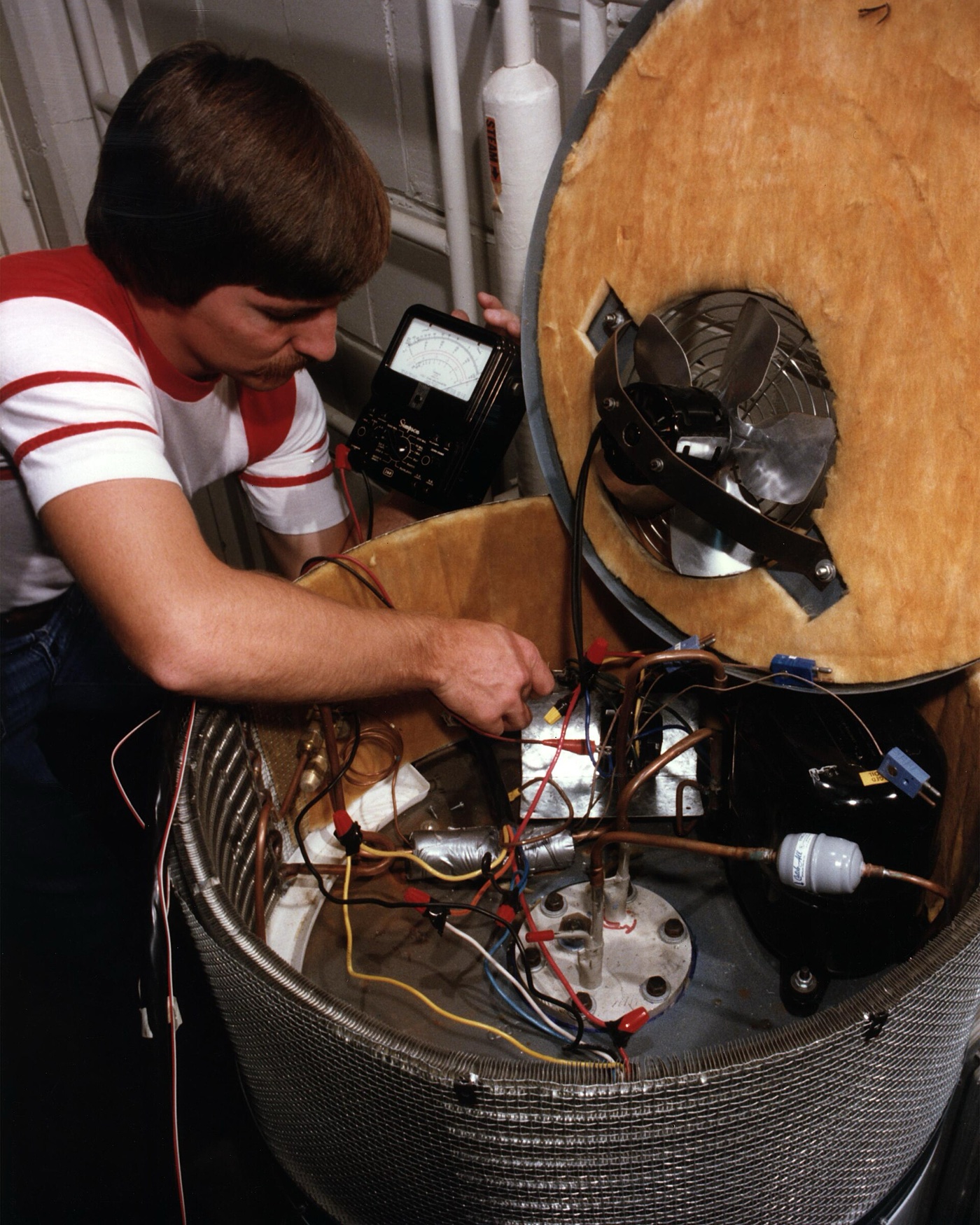
The compressor and fan sit on top of a heat pump tank, which makes it taller than a standard tank and means it needs air and service room above.
Heat pump water heater with the top unit openPhoto: ENERGY.GOV ↗ · Public domain ↗Moving from gas to a heat pump can also mean capping the gas line and sealing the old vent. Switching from gas to electric covers the panel and wiring questions.
Climate: where each type works best
- Hot climates suit heat pumps especially well: a heat pump in a warm garage pulls heat from air you didn’t want anyway, and tankless units deliver more flow when incoming water is warm (Rinnai’s 199,000 BTU/h unit gives 8.8 gpm with 77°F water).
- Cold climates are harder on both. Groundwater near 35°F cuts that same tankless unit to 4.4 gpm. A heat pump in an unheated space below 40°F runs on its elements and loses most of its advantage. In a heated basement it works, and ENERGY STAR cites research finding that its heating savings offset the extra load on the home’s furnace in winter.
- Very cold spaces: split-system heat pump water heaters, with the compressor outdoors, can work down to −25°F according to ENERGY STAR, but cost several times more than standard models.
Maintenance each type needs
- Tank (gas or electric): flush sediment periodically and check the anode rod every 3–4 years, as DOE recommends. See flushing a water heater.
- Tankless: flush or descale the heat exchanger about once a year, more often with hard water, according to Rheem. Clean the inlet water filter. See descaling a tankless water heater.
- Heat pump: everything a tank needs, plus cleaning the air filter on top and keeping the condensate drain clear. Rheem’s models have a washable filter.
A full schedule by type is in water heater maintenance.
Rebates and rules in 2026
- State home electrification rebates. Federal law allows state-run High-Efficiency Electric Home Rebate programs to pay up to $1,750 for a heat pump water heater, covering up to 100% of the cost for households under 80% of area median income and 50% for 80–150%. DOE says these rebates are available in select states; check with your state energy office.
- Utility rebates for heat pump water heaters, and sometimes for high-efficiency gas units, vary by utility. See our rebates guide.
- Federal standards from 2029. DOE’s 2024 rule requires most new electric tank water heaters over 35 gallons made on or after May 6, 2029 to meet a heat-pump-level UEF. As of October 4, 2026, the rule remains in the federal regulations. A separate rule for gas tankless units was overturned by Congress and withdrawn in May 2025.
Electric tanks over 55 gallons already must meet a UEF of about 2.0, which only a heat pump can reach (large grid-enabled tanks used in utility programs are a separate class).
Which one should you choose?
Storage tank
Good
- Lowest installed price
- Simplest same-fuel swap, often same day
- Big bursts of hot water
Watch for
- Runs out in long, busy hours
- Shortest life, about 8–15 years
- Plain electric costs the most to run
Best for: Tight budgets, emergency replacements, gas homes with an existing vent and modest hot water use.
Tankless
Good
- Hot water doesn’t run out within its flow limit
- Wall-mounted, frees floor space
- Longest expected life
Watch for
- Higher price, often with new venting and gas work
- Flow drops with cold incoming water
- Whole-house electric needs a huge service
Best for: Gas homes that run out of hot water, need the space or fill big tubs, and plan to stay long enough to benefit.
Heat pump tank
Good
- Lowest running cost by far
- Fast payback replacing an electric tank
- State and utility rebates where offered
Watch for
- Needs air, a drain and a space above about 40°F
- Slower recovery; may need a bigger tank
- 45–60 dB of fan and compressor noise
Best for: Homes replacing an electric tank, and gas homes with a basement, garage or utility room that suits it.
Quick rules
- You have an electric tank: a heat pump is the default choice if the space works. The running-cost savings are the biggest of any switch.
- You have gas and you’re happy with how much hot water you get: a new gas tank is the low-cost choice; a heat pump is the low-running-cost choice if you can add a circuit and have the room.
- You have gas and you run out of hot water: a larger or higher-input tank, or a gas tankless unit sized for your winter water temperature.
- Your heater just failed: a same-type tank gets hot water back fastest. If you want to switch types, ask whether a repair can buy time; see repair or replace.
- You use propane: propane costs more than natural gas per unit of heat, so on DOE’s prices a heat pump costs about a third as much to run as a standard propane tank.
Questions to ask before you sign
Ask every installer
- What is the exact model, its UEF and its first-hour rating (or gpm at my winter water temperature)?
- Does the price include a new vent, gas line work, a new circuit, a condensate drain or a louvered door?
- For tankless: is my gas line big enough for this unit at its full input, and how did you check?
- For a heat pump: does this space meet the manual’s air volume and temperature limits, and where will the condensate go?
- Who pulls the permit and arranges the inspection?
- What does the warranty cover, for how long, and does it include labor?
Getting two or three quotes on the same type, and at least one on the type you’re curious about, is the fastest way to see what your house really needs. Our guide to comparing quotes shows how to line them up.
Common questions
Is tankless better than a tank water heater?
It’s better at some things: it doesn’t run out within its flow limit, saves floor space and usually lasts longer. It costs more to install and, on our numbers, a gas tankless unit saves only about $85–$130 a year over a standard gas tank, so the extra cost can take 15 years or more to pay back.
Is a heat pump water heater worth it?
If you’re replacing an electric tank, almost always: on DOE’s 2025 average prices a busy household saves about $700 a year, so the extra cost pays back in a few years. Replacing gas, savings are smaller (about $170 a year in our example) and depend on your gas and electric rates and whether you need a new circuit.
What is the cheapest water heater to run?
A heat pump water heater, in most of the US. It uses about a quarter of the electricity of a standard electric tank. A condensing gas tankless unit comes next where natural gas is cheap. Plain electric tanks and electric tankless units cost the most to run.
Do heat pump water heaters work in cold climates?
Yes, if the space they’re in stays above about 40°F, such as a heated basement. In a cold garage they fall back on their electric elements and lose most of their savings. Split systems with an outdoor compressor can work down to −25°F, according to ENERGY STAR.
Can I replace my gas tank with a heat pump water heater?
Usually, yes. You need an electrical circuit (240 V, or 120 V for plug-in models), enough air around the unit, a drain for condensate and a space that stays warm enough. The old gas line is capped and the vent sealed. ENERGY STAR suggests sizing up when replacing gas, because heat pumps recover more slowly.
Is there still a tax credit for a heat pump water heater?
Not a federal one. The IRS says the 25C credit covers improvements made through December 31, 2025. Some states offer rebates of up to $1,750 through federally funded programs, mainly for lower- and moderate-income households, and many utilities offer their own.
How long does each type of water heater last?
Roughly 8–15 years for a storage tank, 13–15 years for a heat pump tank (ENERGY STAR) and 15–20 or more years for tankless (Rheem; DOE says more than 20). Hard water, skipped maintenance and high water pressure shorten all of them.
Does a tankless water heater give instant hot water?
No. It heats water instantly once it starts, but the cold water already in the pipes still has to run out, and the burner takes a few seconds to light. A recirculation pump is what shortens the wait at the tap.
Sources
Sources checked October 4, 2026. Prices, codes and rebates change. Check current details with your installer and local permit office.
- Cost to install a water heater (national installation price ranges) ↗ · Home Depot
- What is Uniform Energy Factor and why does it matter? ↗ · ENERGY STAR
- Residential water heaters key product criteria ↗ · ENERGY STAR
- Certified gas storage and tankless water heaters (data set) ↗ · ENERGY STAR
- Certified heat pump water heaters (data set) ↗ · ENERGY STAR
- Heat pump water heaters ↗ · ENERGY STAR
- Heat pump water heater benefits and savings ↗ · ENERGY STAR
- What goes into the cost of installing a heat pump water heater? ↗ · ENERGY STAR
- Busting myths about heat pump water heaters ↗ · ENERGY STAR
- Do heat pump water heaters work in cold climates? ↗ · ENERGY STAR
- Tankless or demand-type water heaters (archived copy, June 2026) ↗ · U.S. Department of Energy, Energy Saver
- Heat pump water heaters (archived copy, June 2026) ↗ · U.S. Department of Energy, Energy Saver
- Selecting a new water heater (archived copy, June 2026) ↗ · U.S. Department of Energy, Energy Saver
- Estimating costs and efficiency of storage, demand and heat pump water heaters (archived copy, May 2026) ↗ · U.S. Department of Energy, Energy Saver
- Sizing a new water heater (archived copy, July 2026) ↗ · U.S. Department of Energy, Energy Saver
- Storage water heaters (archived copy, May 2026) ↗ · U.S. Department of Energy, Energy Saver
- Representative average unit costs of energy, 2026 (Federal Register 2026-05899) ↗ · U.S. Department of Energy
- 10 CFR 430.32(d): energy conservation standards for water heaters ↗ · Code of Federal Regulations, via Cornell LII
- 10 CFR 430 Subpart B, Appendix E: water heater test procedure ↗ · Code of Federal Regulations, via Cornell LII
- Energy conservation standards for consumer water heaters (final rule, May 2024) ↗ · Federal Register
- Gas-fired instantaneous water heater standards withdrawn (May 2025) ↗ · Federal Register
- DOE residential regulations explained ↗ · A.O. Smith
- Energy Efficient Home Improvement Credit ↗ · IRS
- 42 U.S.C. 18795a: high-efficiency electric home rebate program ↗ · U.S. Code, via Cornell LII
- Home Energy Rebates Program ↗ · U.S. Department of Energy
- Water heater lifespan: when to repair vs. replace ↗ · Rheem
- Tank vs. tankless water heater lifespan comparison ↗ · Rheem
- Things to consider before purchasing a tankless water heater (2021) ↗ · Rheem
- Gas water heater types explained: atmospheric, power vent, direct vent ↗ · Rheem
- 120V vs. 240V heat pump water heaters ↗ · Rheem
- Professional Prestige ProTerra hybrid electric spec sheet (form HP-350-5) ↗ · Rheem, hosted by Unilog
- ProTerra plug-in heat pump water heater spec sheet ↗ · Rheem
- Performance Plus electric water heater spec sheet ↗ · Rheem, hosted by Home Depot
- Performance gas water heater spec sheet (form THD-PGU N Rev. 7) ↗ · Rheem, hosted by Home Depot
- Residential atmospheric vent gas water heaters spec sheet (RG250T6N) ↗ · Bradford White, hosted by Young Supply
- RU series condensing indoor tankless spec sheet ↗ · Rinnai
- US and Canada groundwater temperature map with tankless flow rates ↗ · Rinnai
- Tankless water heaters and the “cold water sandwich effect” ↗ · Rinnai, hosted by Young Supply
- NC-1W condensate neutralizer ↗ · Noritz
- Tempra Trend and Tempra Plus technical specifications (rev. 6.2025) ↗ · Stiebel Eltron
- 2024 IRC Chapter 24, Fuel Gas (G2413 pipe sizing) ↗ · International Code Council