THE SHORT VERSION
- Tanks and heat pump tanks: pick a model whose first-hour rating at least matches your busiest hour of hot water use. Gallons alone don’t tell you that.
- Rough starting point: 1–2 people 30–40 gallons, 2–4 people 40–50, 4–5 people 50–55, more than 5 people 75 gallons or tankless (Rheem’s rule of thumb for gas tanks).
- Tankless: add up the flow of fixtures you run at the same time, then check the unit’s output at your winter temperature rise. A 70°F rise is typical in much of the US.
- Heat pump models recover slowly, so installers often size up one step when replacing a gas tank.
- Oversizing costs you twice: a higher price and more heat lost while the water sits.
The quick answer by household size
If you only want a starting point, household size gets you close. Rheem, one of the largest US water heater makers, publishes this rule of thumb for gas storage tanks:
| People in the home | Starting tank size | When to go bigger |
|---|---|---|
| 1–2 | 30–40 gallons | Long showers, a large soaking tub or frequent guests |
| 2–4 | 40–50 gallons | Two showers back to back every morning |
| 4–5 | 50–55 gallons | Teenagers, laundry and showers in the same hour |
| 5 or more | 75 gallons or tankless | Almost always; check first-hour rating carefully |
Source: Rheem, “What Size Gas Water Heater Do I Need?” A manufacturer rule of thumb, not a sizing calculation. Electric and heat pump tanks deliver less hot water per gallon of tank in the first hour, so they often need the next size up.
Treat the table as a sanity check, not an answer. Two families of four can need very different heaters: one showers at night, spread out; the other has four people showering between 6:30 and 7:30 while the dishwasher runs. The second family needs more hot water in that hour, and that hour is what you size for.
Tanks are sized by first-hour rating, not gallons
The first-hour rating (FHR) is how many gallons of hot water a tank can deliver in one hour, starting full of hot water. It combines two things: how much hot water is stored, and how fast the burner or elements reheat incoming cold water (the recovery rate).
That is why two “50-gallon” heaters can perform very differently. ENERGY STAR gives the example of a 40-gallon tank with a very powerful heat source producing 80 gallons in its first hour. Bradford White lists its 50-gallon, 40,000 BTU/h gas tank (RG250T6N) at a first-hour rating of 89 gallons; Rheem lists its 50-gallon electric Performance Plus with 4,500-watt elements at 62.
Where to find the first-hour rating
- On the yellow EnergyGuide label of a new conventional storage water heater. The FTC’s labeling rule requires the label to show both tank size and first-hour rating.
- On the spec sheet or product page, usually listed as “First Hour Rating” or “FHR” in gallons.
- Heat pump water heaters don’t have to carry an EnergyGuide label, so check the spec sheet.
Work out your peak-hour demand
The method takes ten minutes. Think about the busiest hour of a normal day, usually a weekday morning or a weeknight evening, and count the hot water uses in that hour. The industry worksheet below comes from AHRI, the trade body that certifies water heater ratings; DOE recommends the same approach.
| Use | Gallons of hot water per use |
|---|---|
| Shower | 20 |
| Bath | 20 |
| Shaving | 2 |
| Washing hands and face | 4 |
| Shampooing hair | 4 |
| Hand dishwashing | 4 |
| Automatic dishwasher | 14 |
| Food preparation | 5 |
| Automatic clothes washer | 32 |
Source: AHRI, “Worksheet for Estimating Peak Hour Demand/First Hour Rating” (2011). AHRI notes the worksheet assumes no water conservation measures; WaterSense showerheads and newer dishwashers and washers use less, so it errs on the generous side.
Pick your busiest hour
Choose a real hour from a normal week, not a holiday with house guests. If mornings and evenings are close, size for the bigger one.
Count each use in that hour
AHRI’s example: three showers, one shave, one shampoo and a sink of hand-washed dishes.
Multiply and add
3 showers × 20 = 60 gallons, shave 2, shampoo 4, dishes 4. Total: 70 gallons.
Match the first-hour rating
Look for a first-hour rating at least as large as your total, here 70 gallons. A 50-gallon gas tank rated at 89 covers it; a 50-gallon electric tank rated at 62 does not.
Why gas tanks deliver more than electric tanks the same size
Recovery rate is the number of gallons a heater can raise by a set temperature in an hour; spec sheets usually quote it at a 90°F rise. Burners put out far more heat than electric elements, so gas tanks recover roughly twice as fast.
| Heater | Heat input | Recovery | First-hour rating |
|---|---|---|---|
| Gas tank (Bradford White RG250T6N) | 40,000 BTU/h burner | 43 gallons/hour at 90°F rise | 89 gallons |
| Electric tank (Rheem Performance Plus XE50T09EL45U1) | 4,500 W elements, one at a time | 21 gallons/hour at 90°F rise | 62 gallons |
| Heat pump, 120 V plug-in (Rheem ProTerra PROPH50) | 1,100 W compressor, no elements | 29 gallons/hour at 60°F rise | 51 gallons |
Sources: manufacturer specification sheets for each model. Note the heat pump’s recovery is quoted at a smaller 60°F rise. Check the spec sheet of the exact model you are quoted.
You can check the electric figure yourself. A watt is 3.412 BTU per hour, and heating one gallon of water by 1°F takes 8.33 BTU. So 4,500 W × 3.412 = 15,354 BTU/h, divided by (8.33 × 90°F) is about 20.5 gallons per hour. Rheem’s spec sheet uses the same arithmetic (watts ÷ 2.42 ÷ temperature rise) and lists 21.
Sizing a tankless water heater
A tankless heater has no stored hot water, so first-hour rating doesn’t apply. It is sized by two numbers: the flow rate you need (gallons per minute, gpm) and the temperature rise it must deliver at that flow.
Step 1: add up simultaneous flow
| Fixture | Federal maximum | WaterSense-labeled |
|---|---|---|
| Showerhead | 2.5 gpm at 80 psi | 2.0 gpm or less |
| Bathroom faucet | 2.2 gpm at 60 psi | 1.5 gpm or less |
| Kitchen faucet | 2.2 gpm at 60 psi | Not covered by WaterSense |
Sources: federal plumbing product limits and EPA WaterSense specifications. Older fixtures can exceed these; dishwashers and washers vary by model.
DOE’s example: a bathroom faucet at 0.75 gpm plus a shower at 2.5 gpm needs 3.25 gpm. Two showers and a kitchen faucet at once could need 6–7 gpm.
Step 2: find your temperature rise
Temperature rise is your hot water setting minus the temperature of the water coming into the house. DOE’s example assumes 50°F incoming water heated to 120°F: a 70°F rise. Incoming water is colder in winter and in the north. Rinnai’s groundwater map runs from 35°F in the coldest zones to 77°F in the warmest, and uses 75°F for Hawaii and Puerto Rico. Size for winter, not for the day of the install.
Step 3: read the unit’s output at that rise
Rinnai’s own figures show how much this matters: its 199,000 BTU/h unit is rated for 4.4 gpm where groundwater is 35°F and 8.8 gpm where it is 77°F. DOE gives a similar rule of thumb: a 70°F rise is typically possible at about 5 gpm for gas demand heaters and 2 gpm for electric ones. That is why whole-house electric tankless units struggle in cold-water regions, and why a unit that runs two showers in Phoenix may run only one comfortably in Minneapolis in January.
Sizing a heat pump water heater
Size a heat pump water heater like a tank, by first-hour rating, with one adjustment: it recovers more slowly in its most efficient mode. ENERGY STAR suggests starting from your current tank’s capacity and notes you may want to size up, “particularly when replacing a gas unit.” Rheem suggests a 65- or 80-gallon heat pump water heater for many families of four.
- Bigger tank, same efficiency: a larger heat pump tank lets the compressor do more of the work, so the backup elements run less often.
- Modes matter: “heat pump only” saves the most but recovers slowest; “hybrid” lets the elements help when demand spikes.
- 120-volt models run on a standard or dedicated 15-amp circuit and avoid new 240-volt wiring. ENERGY STAR certifies them as a separate category. Rheem’s 50-gallon plug-in lists a UEF of 3.0 but a first-hour rating of 51 gallons, since its spec sheet lists heat pump operation only; Rheem says the main difference from 240-volt models is recovery speed.
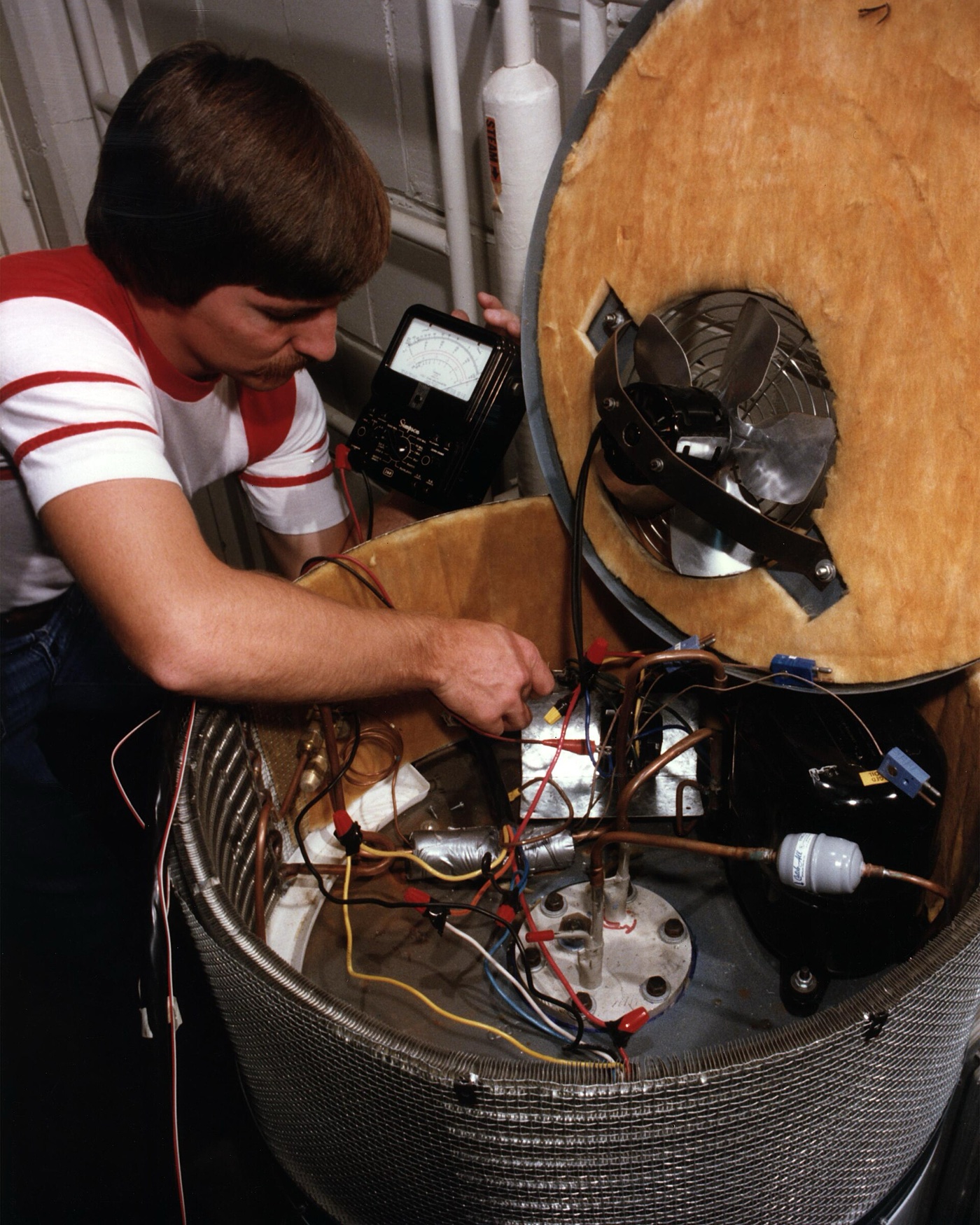
The compressor and fan sit on top of the tank. They need room to breathe, so size the space as well as the tank.
Heat pump water heater with the top unit openPhoto: ENERGY.GOV ↗ · Public domain ↗Why bigger isn’t automatically better
DOE notes that an oversized storage heater carries a higher purchase price and higher energy costs because of standby loss: a tank keeps all its water hot around the clock, and a bigger tank has more surface to lose heat from.
Too small
Good
- Lower price
- Less standby loss
Watch for
- Cold showers at the end of busy mornings
- Elements or burner run hard and often
Best for: Nobody; fix it with first-hour rating, not by turning the thermostat up.
Right-sized
Good
- Covers your real peak hour
- No wasted capacity
Watch for
- Needs ten minutes of counting before you buy
Best for: Almost every household.
Oversized
Good
- Handles guests and big tubs
Watch for
- Higher price
- More heat lost every day
- May not fit the space or the code clearances
Best for: Homes with a real, regular need: a large soaking tub, several simultaneous showers.
Moving up a size can also change the installation. A 75-gallon tank is wider and taller and heavier when full. A taller tank may not fit a closet, and a larger gas burner may need a bigger vent. Ask the installer to confirm fit before you settle on a size.
What to tell an installer so the size is right
Bring this to every quote
- The model number and tank size on your current heater’s label (a photo is best; see the photo checklist)
- How many people live in the home and your busiest hour of hot water use
- Any large soaking tub, body-spray shower or second laundry machine
- Whether you run out of hot water today, and when
- Whether you want to stay with the same fuel or switch
- The available space: closet dimensions, ceiling height, distance to an outside wall
Then ask each installer for the first-hour rating (or, for tankless, the gpm at your winter temperature rise) of the exact model they quote. If two quotes list different sizes, ask why. It is one of the most useful questions when you compare quotes.
Common questions
Is a 40-gallon water heater enough for a family of four?
Sometimes. Bradford White lists its 40-gallon, 40,000 BTU/h gas tank at a first-hour rating of 76 gallons, which covers three 20-gallon showers. A 40-gallon electric tank usually can’t. Count your busiest hour and compare it to the first-hour rating.
Can I replace a 50-gallon tank with a 40-gallon one?
Yes, if the new heater’s first-hour rating still covers your peak hour. If your current heater never runs out, check its first-hour rating on the label and look for a smaller model that matches it. Don’t downsize if you already run short.
What size tankless water heater do I need for a family of four?
Most families of four want enough flow for two showers at once, roughly 4–5 gpm of hot water, at their winter groundwater temperature. Rinnai’s published figures put its 199,000 BTU/h unit at 4.4 gpm with 35°F water and 5.6 gpm with 52°F water, so in cold regions that usually means one of the largest residential gas units. Check the model’s flow chart.
Does a bigger water heater use more energy?
A bigger storage tank loses more heat while it waits, so it usually costs more to run for the same hot water use. A tank that is too small also wastes money if you turn the thermostat up to compensate. Right-sizing is cheapest.
How do I find the first-hour rating of my current water heater?
Look for the yellow EnergyGuide label if it is still on the tank, or search the model number from the rating plate for its spec sheet. The FHR is listed in gallons.
Should I size up if I am switching to a heat pump water heater?
Often, yes. Heat pump tanks recover more slowly in their efficient mode, and ENERGY STAR says you may want to size up, particularly when replacing a gas tank. Compare first-hour ratings to be sure.
What temperature rise should I use for tankless sizing?
Subtract your coldest incoming water temperature from your hot water setting. With 120°F hot water and 50°F incoming water the rise is 70°F. In northern states winter water can be in the 40s or below, so the rise is bigger.
Sources
Sources checked October 4, 2026. Prices, codes and rebates change. Check current details with your installer and local permit office.
- Worksheet for Estimating Peak Hour Demand/First Hour Rating ↗ · AHRI
- Sizing a New Water Heater (archived copy, July 2026) ↗ · U.S. Department of Energy, Energy Saver
- Storage Water Heaters (archived copy, May 2026) ↗ · U.S. Department of Energy, Energy Saver
- 16 CFR 305.17: EnergyGuide label content for water heaters ↗ · Federal Trade Commission, via Cornell LII
- What is Uniform Energy Factor and why does it matter? ↗ · ENERGY STAR
- Heat pump water heaters ↗ · ENERGY STAR
- Residential water heaters key product criteria ↗ · ENERGY STAR
- What size gas water heater do I need for my home? ↗ · Rheem
- 120V vs. 240V heat pump water heaters ↗ · Rheem
- ProTerra plug-in heat pump water heater spec sheet ↗ · Rheem
- Best Management Practice #7: Faucets and showerheads (federal flow limits) ↗ · U.S. Department of Energy, FEMP
- US and Canada groundwater temperature map ↗ · Rinnai
- 2024 IRC Chapter 24, Fuel Gas (G2413 pipe sizing) ↗ · International Code Council
- Residential atmospheric vent gas water heaters spec sheet (RG240T6N, RG250T6N) ↗ · Bradford White, hosted by Young Supply
- Performance Plus electric water heater spec sheet (form THD-P+E9 N) ↗ · Rheem, hosted by Home Depot
- What goes into the cost of installing a heat pump water heater? ↗ · ENERGY STAR
- WaterSense showerheads ↗ · U.S. EPA
- WaterSense bathroom faucets ↗ · U.S. EPA