THE SHORT VERSION
- Carbon monoxide is the gas heater’s main hazard. CPSC estimates water heaters were involved in about 5 non-fire CO deaths a year in 2020–2022. Soot or melted plastic at the top of the tank means exhaust has spilled; get the vent checked.
- Put CO alarms on every level and outside sleeping areas (CPSC), test them monthly (NFPA), and get out and call 911 if one sounds.
- Keep gasoline, solvents and lint away from a gas heater. Tank heaters built since July 2003 have a flame arrestor (FVIR), but A.O. Smith still says never to store or use flammables in the same room.
- Never cap, plug or remove the relief valve. It is the last line of defense if the thermostat and high-limit switch fail.
- Set the tank to 120°F, strap it in quake country, and replace any heater that has been under floodwater.
Five hazards, and the part that guards against each
Most water heaters run for a decade without incident because several devices back each other up. Problems start when one of them is missing, blocked or defeated, often by something in the room around the heater. This table is the map for the rest of the guide.
| Hazard | What guards against it | What defeats the guard |
|---|---|---|
| Carbon monoxide (gas and propane) | A sound vent, enough combustion air, CO alarms | A disconnected or blocked vent, exhaust fans and dryers that depressurize the house, a closet with no air openings |
| Fire from flammable vapors (gas) | Flame arrestor on FVIR heaters, 18-inch garage elevation, distance from flammables | Gasoline or solvents stored nearby; lint clogging the air intake |
| Tank rupture from heat and pressure | Thermostat, high-limit (ECO) cutoff, T&P relief valve | A capped, plugged or undersized relief valve or discharge pipe |
| Scalding | A 120°F setting, shower valve limit stops, mixing valves | A tank turned up without a mixing valve; a failed thermostat |
| Toppling, flooding, shock | Seismic straps, drain pan, shutoff valves, an electrical disconnect | Missing straps in quake zones; a heater reused after a flood |
Sources: CPSC, NFPA, A.O. Smith and Rheem manuals, and the 2024 International Residential Code, cited in each section below.
Which of these apply depends on the heater. Electric tanks burn no fuel, so carbon monoxide and flammable-vapor ignition from a burner don’t apply, but scalding, tank pressure and flooding do. Sealed direct vent and power vent gas heaters tolerate far more house depressurization than open atmospheric (draft hood) models, as the test limits below show; see water heater venting to identify yours.
Carbon monoxide and backdrafting
Source: CPSC, Non-Fire Carbon Monoxide Deaths Associated with the Use of Consumer Products, 2022 Annual Estimates. Most CO deaths involve portable generators; water heaters are a small but steady share, with year-to-year estimates from 2 to 18.
A gas burner that gets enough air and vents properly sends its carbon monoxide (CO) up the flue and outdoors. Two things go wrong. The burner can be starved of air: A.O. Smith says that produces a yellow, sooty flame and a risk of asphyxiation. Or the vent can stop drawing, so exhaust that should rise spills out at the draft hood instead. That is backdrafting or spillage.
Spillage can be intermittent: only when the dryer, the bath fans and the range hood run at once, or only on a mild day when the chimney is weak. That is why it can go unnoticed for years. The Pacific Northwest National Laboratory (PNNL), in a homeowner guide written for DOE, says melted plastic rings around the pipes on top of the tank and soot spots on the tank top show that a heater has backdrafted, now or in the past.
The spillage test is a job for a pro
The reliable check is a worst-case spillage test, from Building Performance Institute (BPI) procedures. In the version Vermont’s energy code references, the technician closes interior doors that make the heater’s room more negative, turns on the dryer and every exhaust fan, and measures the room’s pressure. With the heater firing, they check the draft hood with a smoke puffer or mirror: spilling for more than 60 seconds fails. They also read CO in the flue with a digital meter. The procedure allows a room with a lone atmospheric water heater only 2 pascals of depressurization, against 15 for a fan-assisted water heater and 50 for sealed direct-vent appliances.
Don’t try to fix a spilling vent yourself. Venting, combustion air and gas piping are licensed work, and the fix may be a liner, a new vent or a different heater; water heater venting covers the options and costs.
CO alarms: where they go and what to do when one sounds
- Where: CPSC says to install battery-operated or battery-backup CO alarms on every level of the home and outside sleeping areas, meeting UL 2034. NFPA adds: a central spot outside each sleeping area, following the alarm maker’s mounting instructions.
- Not where: CPSC doesn’t recommend alarms in kitchens or above fuel-burning appliances. PNNL suggests a plug-in combination natural gas, propane and CO alarm near a gas water heater for early warning, placed per its instructions.
- Interconnect them so all sound when one does (NFPA). Test monthly and replace them on the maker’s schedule.
- Codes may require them with the permit. Under the 2024 IRC (R311.2.2), work that needs a permit triggers CO alarms in existing homes, with exceptions that include plumbing work and mechanical systems that aren’t fuel-fired. Ask your permit office whether a water heater replacement counts.
Flammable vapors and FVIR heaters
Gasoline vapor is heavier than air and drifts along the floor until it finds a flame. In 2003, CPSC said gas water heaters igniting flammable vapors were involved in nearly 800 home fires a year, with an average of 5 deaths and 130 injuries. A safety standard effective July 1, 2003 requires 30-, 40- and 50-gallon gas tank heaters to include a flame arrestor: a fine metal screen or ceramic plate that traps and burns vapors inside the combustion chamber instead of letting them ignite the room. Heaters built this way are called flammable vapor ignition resistant (FVIR).
FVIR reduces the risk; it doesn’t make storage near the heater safe:
- Store flammables elsewhere. A.O. Smith’s manual says gasoline and other flammable substances should never be stored or used in the same room as a gas water heater, even one raised 18 inches, and that vapors can be drawn from other parts of the house. CPSC says to keep gasoline out of basements and garages altogether, in closed, labeled, non-glass safety cans.
- Keep the air intake clean. The arrestor can clog with dust and lint, which A.O. Smith says shows up as frequent pilot outages or a tripped thermal switch. Vacuum around the base regularly; its support page shows how to clean the air filter. See pilot light problems.
- Mind other chemicals too. A.O. Smith lists spray propellants, cleaning solvents, refrigerants, pool chemicals and bleach: drawn into the burner, they turn into corrosive acids that damage the heater and vent.
- Keep clothing, cleaning supplies and boxes off and around the heater. A.O. Smith warns they can cause a fire, and don’t wrap an insulation blanket over a gas heater’s air intake.
In garages, codes add a second layer: the ignition source must sit at least 18 inches above the floor unless the heater is listed FVIR (2024 IRC P2801.6), and many local departments still ask for the stand. Details are in where a water heater can go.
The relief valve: last line of defense against a tank failure
A tank heater has three layers of protection against overheating. The thermostat turns the heat off at your setting. If it sticks, a high-limit switch (often called the ECO, energy cut-off) shuts the burner or elements down; on the A.O. Smith gas control described in its manual it can’t be reset, so the control has to be replaced. If both fail, or pressure climbs, the temperature and pressure (T&P) relief valve opens and dumps hot water before the tank can fail.
- Never cap, plug or remove it. A.O. Smith’s manual warns an explosion could occur if the valve or its discharge pipe is blocked.
- The discharge pipe matters as much as the valve: full size, running downhill, no valve or cap, ending near the floor or a drain. The rules are in water heater code requirements.
- Testing: A.O. Smith’s gas manual says to operate the lever at least twice a year; Rheem says at least once a year. Make sure nobody is in front of the outlet and the water has somewhere to go; it can be scalding. If the valve keeps dripping afterward or won’t snap shut, call a plumber.
- A valve that discharges on its own is a symptom, usually of high pressure, thermal expansion or overheating. See relief valve leaking.
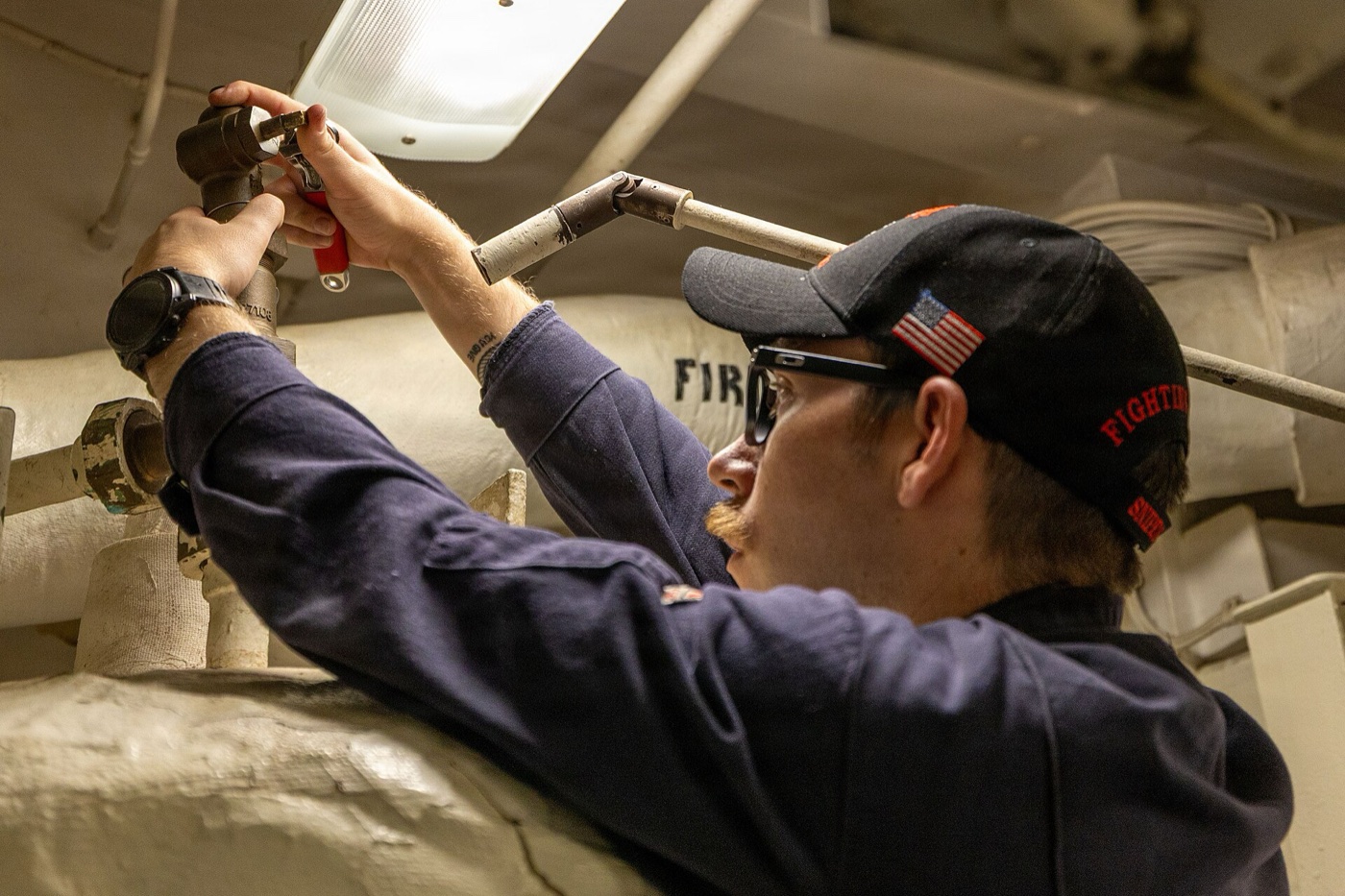
The T&P valve sits at the top or upper side of the tank. The lever is for testing; the pipe below it must stay open.
Technician adjusting the relief valve on a hot water booster heaterPhoto: U.S. Navy (NAVCENT Public Affairs) ↗ · Public domain ↗Scalding: the hazard every heater shares
CPSC urges households to set water heaters to 120°F. Rheem’s manual, citing the Shriners Burn Institute, puts a serious burn at more than 5 minutes of contact at 120°F and less than 5 seconds at 140°F. A.O. Smith adds that frequent short draws can make tap water up to 30°F hotter than the setting. The settings, mixing valves and code limits are covered in what temperature to set a water heater.
Earthquakes, floods and long absences
- Earthquake straps. The 2024 IRC (P2801.7) requires water heaters to be anchored in Seismic Design Categories D0–D2, and in townhouses in category C. California’s Health and Safety Code (section 19211) requires all new, replacement and existing residential water heaters to be braced, anchored or strapped, and home sellers must certify it. A toppled tank can break its gas line.
- Floods. A.O. Smith says not to operate a water heater if any part has been exposed to flooding; flood damage may not be visible, and a flooded heater should be replaced, not dried out. Its electric manual says the same for submerged thermostats or wiring.
- Hydrogen after two weeks unused. A.O. Smith says a hot water system unused for two weeks or more can build up hydrogen gas, which is “extremely flammable and explosive.” Run the hot tap farthest from the heater for several minutes before using a dishwasher or washer, with no smoking or open flame nearby; an unusual sound like air escaping as the tap opens is a sign.
- Leaks. A pan with a drain under a heater where a leak would cause damage is a code requirement in most places; see water heater code requirements.
Warning signs and what to do right now
| What you notice | What it can mean | What to do |
|---|---|---|
| Smell of gas | A gas leak | Don’t light anything or touch switches or phones inside. Leave, then call the gas supplier from a neighbor’s phone, or the fire department (A.O. Smith). |
| CO alarm, or headaches and nausea that ease when you leave the house | Carbon monoxide | Get everyone outside and call 911 (CPSC). Stay out until cleared. |
| Soot or melted plastic on top of a gas tank | The heater has spilled exhaust (PNNL) | Stop using it if anyone has symptoms; book a vent and spillage check. |
| Yellow, lazy burner flame instead of blue | Poor combustion; A.O. Smith says a risk of CO | Call for service; check that the air intake isn’t blocked by lint. |
| Relief valve discharging hot water or steam | Overheating or excess pressure | Keep clear of the pipe, turn off gas or power to the heater, call a plumber. |
| Water much hotter than usual | Stuck thermostat, stacking or a failed mixing valve | Turn the heater down or off and have it checked. |
| Scorched or discolored flame arrestor; won’t relight after a fumes incident | Flammable vapors ignited (A.O. Smith) | Don’t use it; the heater must be replaced. |
| Heater was under floodwater | Hidden damage to controls | Don’t operate it; have it replaced (A.O. Smith). |
Sources: CPSC carbon monoxide Q&A; PNNL Building America Solution Center; A.O. Smith gas and electric manuals. For step-by-step shutoffs, see the water heater emergency guide.
The shutoffs themselves (gas valve, breaker, cold-water valve) are walked through in water heater emergency: the first 10 minutes.
Safety checks you can do, and where to stop
Look, don’t take apart
- CO alarms on every level and outside bedrooms; test monthly
- Nothing stored within a few feet of a gas heater, especially gasoline, paint, solvents, pool chemicals and laundry piles
- Air intake and floor around a gas heater vacuumed free of lint and dust
- Vent pipe connected, sloping up toward the chimney, with no soot or melted plastic at the top of the tank
- Relief valve discharge pipe in place, uncapped, ending near the floor or a drain
- Two straps in place if you’re in earthquake country
- Hot water at the tap measured at about 120°F
- You know where the gas shutoff, breaker and cold-water valve are
Stop there. Gas piping, venting, combustion air, wiring and relief valve replacement are licensed work in most places, and mistakes in them fail silently. If you’re weighing a do-it-yourself replacement, read can you replace a water heater yourself first.
Common questions
Can a water heater cause carbon monoxide poisoning?
A gas or propane one can. CPSC estimates water heaters were associated with about 5 non-fire CO deaths a year in 2020–2022, usually through a blocked, disconnected or backdrafting vent. Electric water heaters burn no fuel and don’t produce CO.
Can a water heater explode?
A tank can rupture violently if it overheats with no working relief path. That is why every tank has a thermostat, a high-limit cutoff and a T&P relief valve. A.O. Smith warns an explosion could occur if the relief valve or its discharge pipe is blocked, so never cap or plug it.
Is it safe to store things next to a water heater?
Keep combustibles like clothing, boxes and cleaning supplies away from it, and never store gasoline, solvents or paint thinner in the same room as a gas heater. A.O. Smith says vapors can travel from other parts of the house to the burner, even with an FVIR heater.
How do I know if my gas water heater is FVIR?
The rating label or manual will say it is flammable vapor ignition resistant, and most have a sealed combustion chamber with an air intake screen at the base. Under the 2003 standard, 30-, 40- and 50-gallon gas tank heaters made after July 1, 2003 have flame arrestors.
Where should a carbon monoxide detector go near a water heater?
CPSC says on every level of the home and outside sleeping areas, not in kitchens or directly above fuel-burning appliances. PNNL suggests a plug-in combination gas and CO alarm near a gas water heater, placed per its instructions. Follow the alarm maker’s mounting guidance.
How often should I test the relief valve?
Rheem says at least once a year; A.O. Smith’s gas manual says twice a year. Lift the lever with nobody in front of the outlet and the discharge going somewhere safe. If it won’t reseat or keeps dripping, call a plumber.
What is backdrafting?
Exhaust from an atmospheric gas heater coming back out of the draft hood instead of going up the vent, often because exhaust fans and a dryer depressurize the house. Soot or melted plastic on top of the tank is a sign (PNNL). A professional checks it with a worst-case spillage test.
Sources
Sources checked October 5, 2026. Prices, codes and rebates change. Check current details with your installer and local permit office.
- Non-fire carbon monoxide deaths associated with the use of consumer products, 2022 annual estimates ↗ · U.S. Consumer Product Safety Commission
- Carbon monoxide questions and answers ↗ · U.S. Consumer Product Safety Commission
- New technology in gas water heaters can save lives (July 8, 2003) ↗ · U.S. Consumer Product Safety Commission
- Avoiding tap water scalds (Publication 5098) ↗ · U.S. Consumer Product Safety Commission
- Carbon monoxide safety tip sheet ↗ · NFPA, hosted by the Village of Penn Yan, NY
- Look for signs of gas water heater backdrafting (updated July 2025) ↗ · Pacific Northwest National Laboratory, Building America Solution Center
- 2020 RBES Appendix RA: procedure for worst-case testing of combustion appliances ↗ · Efficiency Vermont (Vermont Residential Building Energy Standards)
- Residential gas water heater installation and use and care guide (Signature 100, 100341468) ↗ · A.O. Smith, hosted by Lowe’s
- Residential electric water heater use and care guide (100404292, March 2026) ↗ · A.O. Smith, hosted by Lowe’s
- Cleaning the air filter and flame arrestor ↗ · A.O. Smith
- Performance Platinum electric water heater use and care manual ↗ · Rheem
- 2024 IRC Chapter 28, Water Heaters (P2801.6 garages, P2801.7 seismic bracing) ↗ · International Code Council, via UpCodes (Maryland adoption)
- 2024 IRC Chapter 3, Building Planning (R311 carbon monoxide alarms, R301.2.2.10) ↗ · International Code Council, via UpCodes (Maryland adoption)
- California Health and Safety Code §19211 (water heater strapping) ↗ · California Legislature