THE SHORT VERSION
- You need one if your water system is closed and you have a tank heater. A check valve or backflow preventer at the meter, or a pressure-reducing valve (PRV), closes it, and the IRC, IPC and UPC then require thermal expansion control.
- Why: a 50-gallon tank heated from 50°F to 120°F grows by about half a gallon. With nowhere to go, Rheem says less than 20°F of heating can push pressure to the relief valve’s 150 psi.
- Warning signs: a relief valve that drips while the heater runs and no one is using water, dripping faucets, toilets that refill on their own.
- Most 40- and 50-gallon heaters get a 2-gallon tank, pre-charged to house pressure with the water off. Codes that cap pressure at 80 psi can call for the next size up at 60 psi or more.
- Cost: $67–$79 for the tank at two retailers in October 2026; This Old House puts the add-on at $40–$150. Tanks wear out, so have yours checked at service visits.
Heated water grows, and a closed system turns that into pressure
Water takes up more room as it warms. Using the U.S. Geological Survey’s density table, water heated from 50°F to 120°F grows by about 1.1%. Small, until you multiply it by a tank.
| Thermostat setting | Growth | 40-gallon tank | 50-gallon tank |
|---|---|---|---|
| 120°F | 1.1% | 0.45 gallon | 0.56 gallon (about 9 cups) |
| 140°F | 1.7% | 0.67 gallon | 0.83 gallon |
| 160°F | 2.3% | 0.92 gallon | 1.15 gallons |
Ember & Tank arithmetic from the USGS water density table, for a full tank reheated from cold. Amtrol’s sizing guide uses slightly lower factors (1.0% to 120°F from 40°F); Rheem says a 40-gallon heater ends up holding about 40.53 gallons.
In an open system, the extra water pushes back through the meter into the city main. In a closed system, a one-way device blocks that path, and because water doesn’t compress, pressure rises instead. A.O. Smith’s bulletin says water in a closed tank at 50 psi, heated just 10 degrees, would reach 250 psi. In practice something gives first: the temperature and pressure (T&P) relief valve opens at 150 psi, or a weaker fixture leaks.
An expansion tank is a small steel tank split by a rubber diaphragm: water on one side, compressed air on the other. The extra water flows in and squeezes the air; when a tap opens, the air pushes it back out. Pressure still rises, but in the example above by about 10–30 psi instead of 90.
How to tell whether your system is closed
Many homes are closed without the owner knowing. Kingsport, Tennessee, for example, has been fitting meters with dual check valves on new service connections, which it says makes each customer’s plumbing “a ‘closed’ plumbing system.” Any of these closes a system:
- A check valve or dual check valve in the meter or on the main, often added by the water utility to keep household water out of the public supply.
- A backflow preventer on the main.
- A pressure-reducing valve (PRV), required by the IRC where street pressure exceeds 80 psi (P2903.3.2). A.O. Smith notes that “many PRVs also act as very effective check valves.”
- A water softener, which A.O. Smith says may also act as a backflow preventer.
Look along the main
Check the piping between the meter or main shutoff and the heater for a PRV, backflow preventer or softener.
Ask your water utility
Ask whether your meter has a check valve. Utilities that add them often mail a thermal expansion notice like Kingsport’s.
Have a plumber run the gauge test
A.O. Smith’s test puts a gauge with a “dead hand” (a needle that stays at the highest reading) on the heater’s drain valve and lets the heater cycle with no water running. In a closed system “the pressure will start to climb steadily and rapidly.”
What the plumbing codes require
Every major US model code requires thermal expansion control on a closed system with a storage water heater. Your city or county may amend them, so the permit office has the final word. See water heater code requirements for the rest of the installation.
| Code | When it applies | Where and how | Tankless |
|---|---|---|---|
| IRC 2021 and 2024 (P2903.4) | A check valve or backflow device on a system with storage water heating raises pressure, or pressure past a PRV exceeds its setting | “A device for controlling pressure shall be installed.” No sizing target | Rule is written for storage water heating |
| IPC 2021 and 2024 (607.3) | A storage heater’s cold supply passes a check valve, PRV or backflow preventer | On the cold supply, downstream of all such devices; sized per the tank maker and so pressure stays within 80 psi (604.8) | Rule is written for storage heaters |
| UPC, as adopted in California (608.2, 608.3) | Any device that stops pressure dissipating to the main, “independent of the type of water heater used” | Listed, sized tank or other approved device on the building side, “securely fastened to the structure”; one after every pressure regulator to hold 80 psi | Exempt: not required “for an instantaneous non-storage water heater” |
Sources: 2021 IRC (Colorado) and 2024 IRC (Maryland), 2021 IPC (Texas) and 2024 IPC (Maryland), all read on UpCodes; 2025 California Plumbing Code, effective January 1, 2026. Local amendments can change any of these.
Everywhere, the T&P relief valve is not expansion control. The IPC says so (504.4), A.O. Smith calls it “an emergency relief device only,” and Watts explains that a valve dripping constantly builds up minerals that can eventually block it.
Signs that thermal expansion is causing trouble
A.O. Smith notes the effects “are only noticeable after hot water use followed by periods of no water use,” while the heater reheats with every valve shut. Signs:
- The T&P valve drips during heating cycles with no water in use. Rheem says about one cup per 10 gallons of tank, each cycle, is a good indication.
- Faucets drip while the heater recovers, then stop (A.O. Smith).
- Toilets refill on their own as pressure forces water past the fill valve (Watts, Amtrol).
- A surge of water when a tap first opens, and creaking pipes during heating (A.O. Smith).
- Failed solenoid valves and hoses on dishwashers, washers and ice makers (Kingsport, Amtrol).
- A domed top or bottom on the heater, which Rheem says means pressure above its 300 psi test pressure, not covered by warranty.
A.O. Smith’s heater manual says thermal expansion “can cause premature tank failure (leakage)” and that neither that nor the resulting relief valve discharge is covered by its warranty.
Sizing: most homes need a 2-gallon tank, but check the pressure limit
Size depends on the heater’s capacity, its temperature setting and your house pressure. Higher pressure means the air starts out more squeezed, so each gallon of tank absorbs less. Manufacturers publish quick charts:
| Water heater | 40 psi house pressure | 60 psi | 80 psi |
|---|---|---|---|
| 40 gallons | ST-5 (2.0 gal) | ST-5 | ST-5 |
| 50 gallons | ST-5 | ST-5 | ST-5 |
| 60 gallons | ST-12 (4.4 gal) | ST-12 | ST-12 |
| 80 gallons | ST-12 | ST-12 | ST-12 |
| 120 gallons | ST-12 | ST-12 | ST-25V (10.3 gal) |
Source: Amtrol brochure MC4090 (09/25). Basis: 40°F incoming water, a 150 psi T&P valve, pre-charge equal to house pressure. Watts’ PLT chart also assumes a 150 psi relief setting.
Worked example: one heater, two pressure limits
Amtrol’s sizing guide gives the formula behind its chart: tank volume = expanded water × (maximum pressure + 14.7) ÷ (maximum pressure − house pressure). A 50-gallon heater at 120°F, using Amtrol’s 1.0% factor, makes 50 × 0.010 = 0.5 gallon of expanded water.
| House pressure | Stay under 150 psi (relief valve) | Stay at or under 80 psi (IPC 607.3, UPC 608.2) |
|---|---|---|
| 40 psi | 0.5 × 164.7 ÷ 110 = 0.75 gal: 2-gal tank | 0.5 × 94.7 ÷ 40 = 1.18 gal: 2-gal tank |
| 50 psi | 0.82 gal: 2-gal tank | 1.58 gal: 2-gal tank |
| 60 psi | 0.92 gal: 2-gal tank | 2.37 gal: 4.4-gal tank |
| 70 psi | 1.03 gal: 2-gal tank | 4.74 gal: bigger tank or lower pressure |
Ember & Tank arithmetic with Amtrol’s formula and expansion factor; it reproduces Amtrol’s published factors at 150 psi (1.5, 1.6, 1.8, 2.1). Tank sizes are Amtrol’s ST-5 (2.0 gal) and ST-12 (4.4 gal). Follow the tank maker’s instructions for a real selection.
The quick charts keep pressure below the relief valve. The IPC and California’s code ask for 80 psi or less, which at 60–70 psi of house pressure takes more tank. That is one reason A.O. Smith recommends incoming pressure of 60 psi or less, with a PRV set to 40–60 psi where supply pressure is higher.
The pre-charge must match your house pressure
Factory air pressure varies by brand: Amtrol’s current in-line tanks ship at 50 psi, Zurn’s XT at 40 and Watts’ PLT at 20. Every maker says to set the pre-charge (the air pressure in the empty tank) equal to your house water pressure before the tank goes in.
- Too low: house pressure pushes water in before anything has heated. Amtrol shows 70 psi water against a 40 psi tank taking up “valuable space before the water has even begun to heat and expand.”
- Too high: the tank accepts no water until system pressure exceeds the pre-charge (Amtrol), so pressure climbs unchecked first.
- High house pressure shrinks capacity. Watts rates its 2.1-gallon PLT-5 at 1.48 gallons of acceptance with a 20 psi pre-charge, 0.80 at 80 psi. Watts, Rheem and Zurn cap the air charge at 80 psi.
How the pre-charge is checked
It takes an ordinary tire gauge on the air valve, but the reading means nothing while the tank holds water under pressure. A.O. Smith’s tank manual: shut off the main, open a nearby faucet until the water stops, then read and adjust with a tire gauge and a manual pump. Watts and Rheem say to adjust only at zero water pressure; Zurn says to check once a year.
Where it goes and how it is held up
- On the cold supply, on the house side of every check valve, PRV and backflow preventer (IPC 607.3; Amtrol, Watts, A.O. Smith). Amtrol calls hot-side placement incorrect: water parked in the tank cools and comes out first at a hot tap.
- At least 18 inches from the heater’s cold inlet (A.O. Smith’s tank manual).
- Oriented as the maker allows. Amtrol recommends hanging the tank below a tee, with upside-down and horizontal as alternatives. Watts prefers vertical; Watts and Zurn require support when horizontal.
- Supported. Watts and A.O. Smith let small tanks hang from braced pipe; California’s code requires the tank be “securely fastened to the structure.” A failed 2-gallon tank full of water weighs about 22 pounds (5 pounds of steel plus 2 gallons at 8.34 pounds), so a strap is cheap insurance anywhere.
- Where a leak won’t do damage, and above freezing. A.O. Smith and Rheem both warn that every expansion tank will eventually leak.
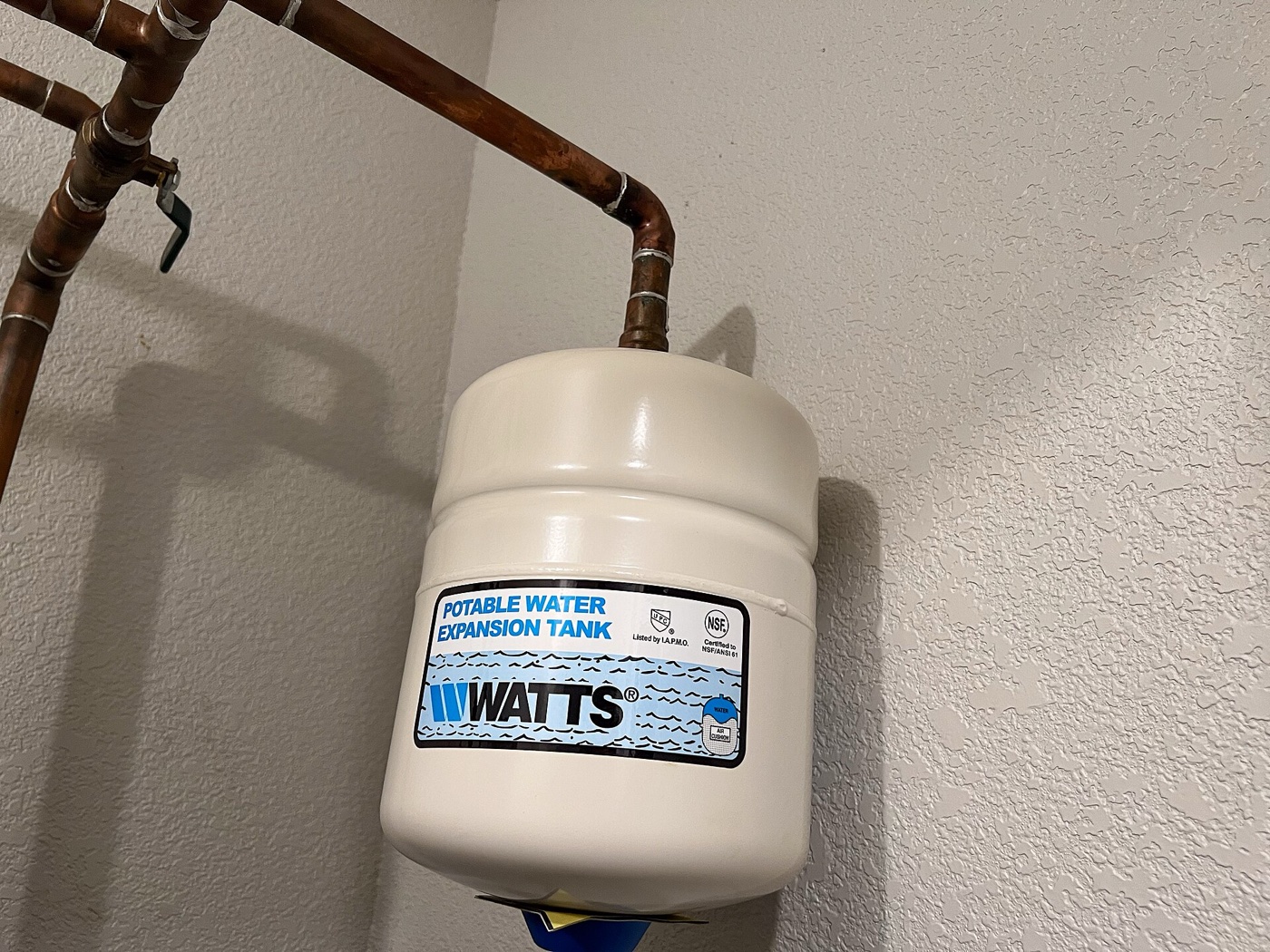
An expansion tank teed into the cold supply above a water heater. The air valve is on the end opposite the pipe connection.
Thermal expansion tank on a water linePhoto: Tony Webster ↗ · CC BY 2.0 ↗Installing one means draining down the water and cutting into the cold line, so it is normally done by the plumber installing or servicing the heater. Amtrol has installers crack a hot tap during the first heat-up to bleed off the initial expansion. See what happens on installation day.
How expansion tanks fail, and how to tell
Tanks fail by losing their air cushion: air seeps out through the valve, or the diaphragm tears and water fills the air side. The tank becomes waterlogged, absorbs nothing, and the thermal expansion symptoms come back.
Signs a tank has failed
- Symptoms return: a dripping relief valve, refilling toilets, dripping faucets
- With the water pressure off, the tire gauge reads zero, or water comes out of the air valve. Zurn says either means the tank “should be replaced.”
- On Amtrol tanks with an InSight cap, the sight glass turns from clear to discolored
- Rust or a weep at the seam or connection
No manufacturer publishes a service life. Amtrol warrants its ST-5 and ST-12 for 7 years; A.O. Smith, Watts and Zurn give 1 year on small tanks. Roto-Rooter, a plumbing company, says tanks typically last five to ten years and that its plumbers test them by tapping the tank or checking air pressure at the valve. When you replace a water heater, ask whether the existing tank is worth keeping.
What an expansion tank costs
| What | Price | Source and what's included |
|---|---|---|
| Amtrol ST-5 (2 gallons), tank only | $67.02 | Home Depot product page, October 4, 2026 |
| Amtrol ST-5 (2 gallons), tank only | $78.95 | Global Industrial product page, October 4, 2026 |
| Expansion tank required by code, added to a water heater installation | $40–$150 | This Old House installation cost guide, updated June 2026 |
Retail prices change often and exclude fittings, labor and any PRV. This Old House doesn’t say exactly what its range includes.
On a closed system, the tank on your quote isn’t an upsell: code requires expansion control, and A.O. Smith’s warranty excludes expansion damage. Ask for it as its own line item so you can compare quotes item by item; more in what makes one installation cost more.
Alternatives: relief valves that dump the extra water
Watts divides expansion control into containment (a tank stores the extra water and returns it) and relief (a valve lets water out at a set pressure below the T&P setting). The IRC asks for “a device for controlling pressure” and the UPC allows “other approved” devices, so relief valves can qualify where the inspector accepts them.
Expansion tank
Good
- Wastes no water
- No drain line needed
Watch for
- Needs the right size and pre-charge
- Loses air over time
Best for: Almost every closed system with a tank heater.
Thermal expansion relief valve
Good
- No air charge to maintain
- Compact; Watts’ LFBRV combines one with the cold shutoff
Watch for
- Dumps water every cycle; Watts says relief products “do not prevent against loss of water”
- Needs a drain; Sioux Chief’s 648 opens at 125 psi, well above 80
Best for: Spaces where a tank won’t fit, if the inspector approves.
Relief toilet fill valve
Good
- Watts’ Governor 80 replaces a toilet fill valve and relieves at 80 psi into the tank
Watch for
- Wastes the relieved water
- Needs local approval as the system’s expansion control
Best for: A supplementary fix; check local acceptance first.
Lowering house pressure is a companion fix, not an alternative: a PRV at 40–60 psi, as A.O. Smith suggests, shrinks the tank needed, but the PRV itself closes the system.
Tankless water heaters: usually exempt, but read the manual
A tankless water heater holds little water, so it makes little expanded water. The UPC, as adopted in California, says an expansion tank “shall not be required for an instantaneous non-storage water heater,” and the IRC and IPC rules are written around storage heaters.
Manufacturers are more cautious. Rinnai’s manual says that in a closed system, such as one with a backflow preventer, “means shall be provided to control thermal expansion.” Amtrol sells a small ST-1 tank for tankless and point-of-use heaters holding 2 gallons or less. Follow your model’s manual and your inspector.
Common questions
Do I need an expansion tank if I have a pressure-reducing valve?
Usually yes. A PRV blocks expanded water from flowing back to the main, and A.O. Smith notes many PRVs act as effective check valves. The IRC (P2903.4.1) requires expansion control when pressure downstream of a PRV exceeds its setting, and the IPC and UPC require it wherever a PRV feeds a storage water heater.
Can an expansion tank go on the hot water side?
Install it on the cold supply. The IPC requires the cold supply, and Amtrol labels hot-side placement incorrect because water stored in the tank cools and is delivered first when you open a hot tap. Some relief valves may go on either side, but tanks belong on the cold line.
How do I know if my expansion tank is bad?
The old symptoms return: a dripping relief valve, refilling toilets, dripping faucets. With the water pressure off, a tire gauge on the air valve reads zero, or water comes out of the valve; Zurn says either means replace it. A plumber can confirm it during a service visit.
What should the expansion tank be pressurized to?
The same as your static house water pressure, set with the tank empty and the system at zero pressure. Factory settings vary from 20 to 50 psi by brand, so a new tank almost always needs adjusting. Watts, Rheem and Zurn cap the air charge at 80 psi.
Do I need a new expansion tank with a new water heater?
Not automatically, but it is the best time to replace an old one: the water is already off and the plumber is there. If your system is closed and you have no tank, a permitted replacement will usually have to add one. Roto-Rooter says tanks typically last five to ten years.
Is an expansion tank required for a tankless water heater?
Usually not by code: the UPC exempts instantaneous non-storage heaters, and the IRC and IPC rules address storage heaters. But Rinnai’s manual still calls for thermal expansion control in a closed system, so follow your heater’s manual and your local inspector.
Can I install an expansion tank myself?
It is plumbing work on your water supply: shutting off and relieving the pressure, draining the heater, cutting a tee into the cold line, setting the pre-charge at zero pressure and supporting the tank. Amtrol, Watts and A.O. Smith write their instructions for licensed or qualified installers, and whether a homeowner may do the work, and whether it needs a permit, is set locally. See can you replace a water heater yourself.
Sources
Sources checked October 4, 2026. Prices, codes and rebates change. Check current details with your installer and local permit office.
- Technical Bulletin 45: Thermal expansion ↗ · A.O. Smith
- Technical Service Bulletin: Thermal expansion (1209) ↗ · Rheem
- Technical Service Bulletin TB-1235: Installation of an expansion tank (2019) ↗ · Rheem
- Water density (temperature table) ↗ · U.S. Geological Survey, Water Science School
- Sizing the Therm-X-Trol (MC10007, 2019) ↗ · Amtrol
- Therm-X-Trol water heater expansion tanks brochure (MC4090, 2025) ↗ · Amtrol
- Therm-X-Trol homeowner brochure (MC10230, 2024) ↗ · Amtrol
- ST-1 tankless expansion tank installation and operation instructions ↗ · Amtrol
- Water heater thermal expansion tanks owner’s manual (100306555) ↗ · A.O. Smith, hosted by aosmithatlowes.com
- Residential gas water heater installation instructions and use and care guide (Signature 100, 100341468) ↗ · A.O. Smith
- PLT-5 and PLT-12 potable expansion tank installation instructions (IS-PLT) ↗ · Watts, hosted by AF Supply
- Thermal expansion products guide (2013) ↗ · Watts, hosted by InspectAPedia
- Model XT water thermal expansion tanks installation and maintenance instructions ↗ · Zurn Wilkins
- 648 Series thermal expansion relief valve spec sheet ↗ · Sioux Chief
- FWL-2 pressure-only relief valve spec sheet ↗ · Cash Acme
- Rinnai tankless water heater installation and operation manual ↗ · Rinnai, hosted by Lowe’s
- 2021 IRC Chapter 29, Water Supply and Distribution (P2903.3.2, P2903.4) ↗ · International Code Council, via UpCodes
- 2024 IRC Chapter 29, Water Supply and Distribution (P2903.4) ↗ · International Code Council, via UpCodes
- 2021 IPC Chapter 6, Water Supply and Distribution (607.3, Texas adoption) ↗ · International Code Council, via UpCodes
- 2024 IPC Chapter 6, Water Supply and Distribution (604.8, 607.3) ↗ · International Code Council, via UpCodes
- 2024 IPC Chapter 5, Water Heaters (504.4) ↗ · International Code Council, via UpCodes
- 2025 California Plumbing Code §608.3, expansion tanks and T&P valves ↗ · California Building Standards Commission, via GoCodebook
- 2025 California Plumbing Code §608.2, excessive water pressure ↗ · California Building Standards Commission, via GoCodebook
- Thermal expansion (customer notice) ↗ · City of Kingsport, Tennessee, Water Services
- Director’s Rule CS-327: billing adjustments for expansion tanks on open systems ↗ · Seattle Public Utilities
- How much does it cost to install a water heater? (updated June 2026) ↗ · This Old House
- Amtrol Therm-X-Trol ST-5 expansion tank (product page) ↗ · Home Depot
- Therm-X-Trol water heater expansion tank ST-5 (product page) ↗ · Global Industrial
- What is a thermal expansion tank and why you might need a new one (February 2026) ↗ · Roto-Rooter (plumbing company)