THE SHORT VERSION
- The anode is the tank’s rust protection. It’s a rod of magnesium or aluminum that corrodes in place of the steel. Once it’s used up, the steel starts to rust, and a rusted-through tank can’t be repaired.
- Check intervals vary by maker: A.O. Smith says inspect after 6 months, then yearly; Rheem’s manual says yearly; Bradford White says every 2 years; DOE says every 3–4 years. Check sooner if you have a water softener.
- Replace it when the core wire shows: Rheem’s rule is more than 6 inches of bare core wire at either end; Bradford White’s is any exposed core, or wear to about half the original thickness.
- Rotten-egg smell from the hot tap only is usually bacteria reacting with the anode’s chemistry. A different anode (aluminum/zinc or powered) plus disinfecting the tank often fixes it. Never just pull the anode out: makers say that voids the tank warranty.
- Cost: the rod is about $28–$35 at Home Depot ($180 for a powered one). HomeAdvisor puts a replacement at $50–$150 installed, Fixr at $125–$300.
The anode corrodes so the steel tank doesn’t
A tank water heater is a steel pressure vessel lined with a thin layer of glass (porcelain enamel) fused to the steel in a furnace. The lining is never perfect. Rheem’s technical bulletin on the subject says every glass-lined tank, “no matter how carefully it is manufactured,” has microscopic bare steel exposed to the water, and chips, welds and pipe fittings add more.
That bare steel would rust quickly in hot water. So every tank has at least one anode rod: a bar of a more reactive metal, usually magnesium, screwed into the top. When two metals share the same water, the more reactive one corrodes first and protects the other. A.O. Smith calls this cathodic protection and lists magnesium and aluminum as the most common anode metals because they sit near the top of the galvanic series, well above steel.
The anode is meant to be used up. Rheem says that as long as an active magnesium anode remains, the small areas of exposed steel don’t corrode. When the rod is gone, they do. Rust eventually eats through the tank wall, and a leaking tank means a new heater (see how long water heaters last).
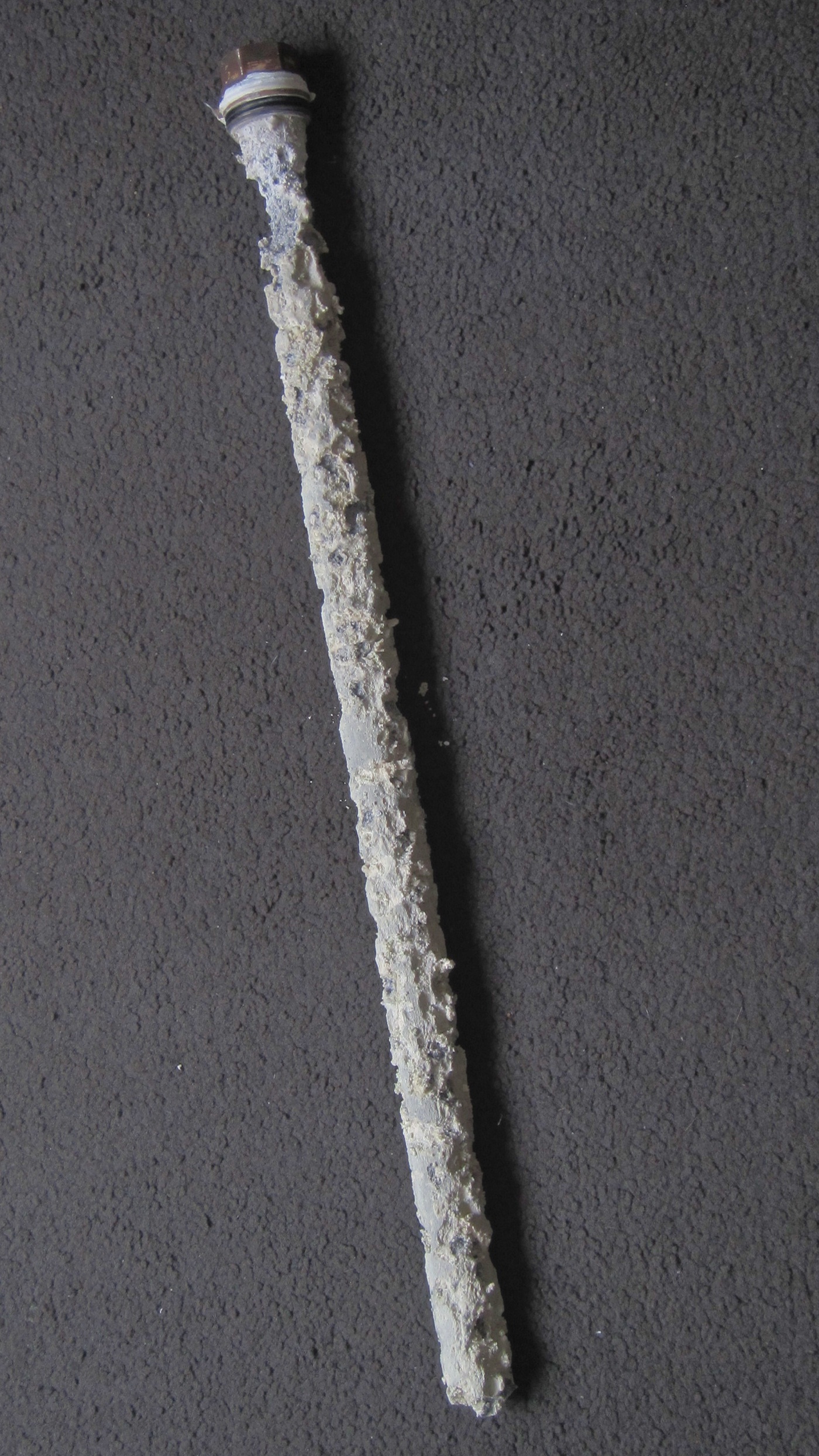
A used magnesium anode pulled from a tank, pitted and crusted where the metal has been consumed. Once the steel core wire shows, it’s time for a new one.
Depleted magnesium anode rodPhoto: Stefan Oemisch ↗ · CC BY-SA 4.0 ↗What uses an anode up faster
- Water chemistry, above all. Rheem calls it “the most important factor”: the more conductive the water, the more current the anode puts out and the sooner it’s gone.
- A water softener. Softening swaps calcium for sodium but leaves the water just as conductive, and it stops the thin scale film that partly protects bare steel. A.O. Smith and Bradford White both say to expect faster anode use and to inspect more often. See hard water and softeners.
- Heat, heavy use and iron bacteria. Rheem lists water temperature and the amount of water used; A.O. Smith says iron bacteria contribute to premature anode failure.
How often to check it, by manufacturer
Makers don’t agree, partly because water varies so much. Follow your own heater’s manual, and if the anode has never been looked at, don’t wait past year 2 or 3. With a softener, go earlier.
| Source | How often | When to replace |
|---|---|---|
| A.O. Smith (gas tank manual) | After the first 6 months or at the first flush, then yearly; more often with a softener | When “substantially worn out or depleted” |
| Rheem (electric use & care manual, bulletin 1201) | Remove and inspect yearly | When more than 6 inches of core wire is exposed at either end |
| Bradford White (gas manual and service manual) | Every 2 years; more often with softened or phosphate-treated water | When worn to about half its original diameter, or any steel core shows |
| DOE Energy Saver | Every 3–4 years | Not specified |
| Rheem (owner article) | Not specified | Every 3–4 years |
Sources: A.O. Smith Signature 100 manual 100341468; Rheem Use & Care Manual AP17547-1 and Technical Service Bulletin 1201; Bradford White manuals 238-51007-00R and 238-51542-00C; DOE Energy Saver “Storage Water Heaters” (archived); Rheem “Water Heater Lifespan: When to Repair vs. Replace.”
Magnesium, aluminum/zinc, combination, flexible and powered anodes
Most heaters ship with magnesium; Rheem calls it “the standard anode,” and Bradford White’s parts list shows a magnesium anode. The other types solve specific problems: odor, low ceilings, or rods that wear out too fast.
| Type | Best for | Watch for |
|---|---|---|
| Magnesium (hex head) | Most water; the factory default | Can feed rotten-egg odor where water has sulfate and sulfate-reducing bacteria; wears fast in softened or highly conductive water |
| Aluminum/zinc (“zinc” anode) | Rotten-egg odor in unsoftened water; sold as an odor fix | Two water heater specialists writing in a trade magazine say it often fails to fix odor in softened water |
| Combination (outlet) anode | Heaters built with the anode in the hot outlet nipple, such as Bradford White; adding a second anode | Removing it means disconnecting the hot water pipe |
| Flexible (segmented) | Low ceilings: one aluminum/zinc rod installs with 14 inches of clearance | Same metals as rigid rods, so the same odor and softener caveats apply |
| Powered (impressed current) | Persistent odor; softened water; owners who don’t want to replace rods | Costs about $180; needs an outlet and must stay plugged in; long-life and warranty claims come from the seller |
Sources: Bradford White manual 238-51007-00R; Rheem bulletins 1201 and 1206; Home Depot listings for Everbilt EBAR-42-07, Rheem SP8371B and Corro-Protec 96387 (checked 2026-10-04); Schuyler and Weingarten, Water Technology, 2011.
Aluminum and aluminum/zinc
Aluminum is less active than magnesium, so it puts out less current, which matters for odor (next section). Aluminum/zinc rods, roughly 92% aluminum and 7% zinc, are sold as odor fixes. Two water heater specialists writing in the trade magazine Water Technology in 2011 say they often work when no softener is installed. Rheem’s odor bulletin recommends its own R-Tech anode, which it says reduces anode activity.
Combination and outlet anodes
A combination anode hangs from the hot water outlet nipple. Bradford White builds its standard heaters this way. Others add one as a second anode: Rheem’s ProtectionPlus kit is a magnesium anode on a plastic-lined hot-side nipple, and it extends the tank warranty from 6 to 10 years.
Flexible (segmented) anodes
A standard rod is nearly as long as the tank is tall (Rheem’s SP11309C is 44⅜ inches), and pulling one out needs that much headroom. Segmented rods are short sections joined by a cable or links, so they bend as they go in. Everbilt’s 3-section aluminum/zinc rod lists installation with only 14 inches of clearance, and Rheem sells a 4-section flexible magnesium rod. A stuck old rigid rod in a low space may have to be cut in pieces as it comes out.
Powered (impressed-current) anodes
A powered anode is a titanium rod that doesn’t corrode. A small power supply plugged into a 120-volt outlet pushes a tiny current through it to do the anode’s job electrically. Some heaters come with one: Stiebel Eltron’s Accelera heat pump water heaters use an “electronic anode … instead of an anode rod,” and A.O. Smith offers one as an option on its Vertex HV condensing gas tank.
Aftermarket kits make big claims. Corro-Protec, the brand Home Depot sells, says its rod eliminates sulfur smell, gives “permanent corrosion protection,” uses about 10 kWh a year and carries a 20-year warranty. Those are the seller’s claims; we found no independent test. It also says the rod is compatible with your heater’s warranty under federal law. The heater manuals we read don’t mention powered anodes, so ask your heater’s manufacturer first.
Rotten-egg smell: the anode is part of the chemistry
If only your hot water smells like rotten eggs, the water heater is the likely source, says the Vermont Department of Health. The smell is hydrogen sulfide gas. A.O. Smith’s manual says four things must all be present: sulfate in the water, little dissolved oxygen, sulfate-reducing bacteria in the tank (harmless to people), and an excess of hydrogen in the tank, which comes from the anode’s protective action. The more active the anode, Rheem says, the more of that hydrogen and the more smell.
Confirm it’s the heater
After you’ve been out for a few hours, smell the hot and cold taps separately. Hot only points to the heater; both hot and cold points to the well or plumbing (Vermont Department of Health).
Disinfect the tank
A.O. Smith and Rheem both describe chlorinating the tank and hot lines. It means opening the tank and draining hot water, so it’s usually a plumber’s job. Rheem says only continuous chlorination of the supply is fully effective.
Swap the anode for a less active one
A.O. Smith says odor may be eliminated or reduced in some models by replacing the anode with one “of less active material.” Bradford White says an alternative anode from your installer will “minimize the odor while protecting the tank.”
If it persists, treat the water supply
A.O. Smith suggests chlorination or aeration of the supply. Powered anodes are another option sellers market for this.
Rusty or black water is a related problem with different causes; both are covered in smelly or discolored water. A.O. Smith notes that sulfate-reducing bacteria thrive below 138°F, which is why some fixes involve heating the tank. That raises scald risk, so leave it to a pro and see water heater temperature.
What checking or replacing an anode involves
You can’t see an anode without taking it out, and that is a real plumbing job: hot water, a stuck fitting and an opened tank. Rheem publishes steps for confident owners and tells everyone else to call a licensed plumber. Here is what the job involves.
- Turn the heater off at the breaker or the gas control, and shut the cold water supply to the tank.
- Relieve pressure and drain some water. Rheem’s procedure drains about 2 gallons. A combination anode on the hot outlet needs the tank drained below the outlet and the hot pipe disconnected (Bradford White).
- Get to the rod. It’s usually under a plastic cap and insulation on top of the tank. On some power-vent models the blower has to come off first (Rheem).
- Break it loose. Rheem specifies a 1-1/16-inch socket and says a long cheater bar is needed “in most cases.” Corro-Protec’s guide suggests a breaker bar, impact wrench or torque multiplier for stuck rods.
- Inspect, then reinstall or replace with thread tape or pipe dope, refill, and check for leaks right away and again 24 hours later (Rheem).
Some anodes can’t be reached
Rheem’s bulletin says the anode isn’t accessible on some of its heat pump water heaters, small point-of-use tanks (20 gallons or less), residential direct-vent models and some manufactured-housing models. Check your manual before booking an anode service. Tankless heaters have no anode at all; their upkeep is descaling (see tankless water heaters).
What a new anode costs
| Item | Price | What's included |
|---|---|---|
| Rheem PROTECH magnesium rod, 44⅜ in. (SP11309C) | about $28 | Part only |
| Everbilt 3-section aluminum/zinc rod, 42 in. (EBAR-42-07) | about $35 | Part only |
| Rheem PROTECH flexible magnesium rod, 54 in. (SP8371B) | about $95 | Part only |
| Corro-Protec powered anode, 40–89 gal (96387) | about $180 | Part only |
| Anode rod replacement, HomeAdvisor range | $50–$150 | Parts and labor |
| Anode rod replacement, Fixr range | $125–$300 | Labor included |
Part prices: homedepot.com product pages, checked October 4, 2026; prices change. Installed ranges: HomeAdvisor (updated June 2026) and Fixr (updated August 2025), both lead-generation sites, shown side by side because they disagree.
The rod is a small part of the bill; you mostly pay for the trip, the draining and breaking loose a rod that has sat in the tank for years. Adding the check to a visit you’re already paying for, such as a flush or a repair, is the cheapest way to get it done.
Does replacing the anode make a heater last longer?
The manufacturers’ own words point that way. A.O. Smith says the anode “helps reduce corrosion and premature failure (leaks),” lists a rod worn down to its core wire among the causes of premature tank failure, and tells owners to replace it when depleted. Rheem’s ProtectionPlus kit, which is essentially an extra anode, adds 4 years to the tank warranty.
Nobody publishes how many years a new anode buys. Two specialists who sell powered anodes wrote that a tank whose anode is kept replaced will “never fail due to rusting through,” but that’s an opinion, not a measured result. Tanks also fail from thermal expansion, sediment and fittings, which an anode doesn’t prevent.
A practical rule: on a heater a few years old, an anode check is cheap insurance. Past about 10 years, when Rheem says leak risk rises significantly and ENERGY STAR says to consider replacing, put the money toward planning a replacement instead, especially if the tank already shows rust. See repair or replace.
Anode questions to ask when you buy a new heater
Ask before you sign
- Where is the anode on this model (its own port or the hot outlet), and is it reachable here with our ceiling height?
- How many anodes does it have, and is a second anode or a longer tank warranty available?
- We have a softener (or well water, or a sulfur smell). Which anode do you recommend, and when should we have it checked first?
- What do you charge to check the anode during a flush?
- If we ever want a powered anode, does the manufacturer say it affects the warranty?
Common questions
How do I know if my anode rod is bad?
You have to take it out and look. Rheem says replace it once more than 6 inches of steel core wire shows at either end; Bradford White says replace it at half its original thickness or when any core shows. Rotten-egg smell from the hot tap can also point to the anode’s chemistry, though the rod isn’t necessarily worn out.
How long does an anode rod last?
It depends mostly on your water. Rheem calls water chemistry the most important factor, and softened water uses anodes up faster. That’s why intervals run from yearly checks (A.O. Smith, Rheem) to every 2 years (Bradford White) to every 3–4 years (DOE).
Is an aluminum or magnesium anode better?
Magnesium is the standard and the more active of the two. Aluminum and aluminum/zinc rods are sold mainly to reduce rotten-egg odor. If you don’t have an odor problem, stay with what your manufacturer specifies.
Can I remove the anode rod to stop the smell?
Don’t. A.O. Smith, Rheem and Bradford White all say running without an anode voids or excludes the tank warranty, and Rheem says it greatly shortens tank life. Disinfect the tank and swap to a less active or powered anode instead.
Does a water softener ruin the anode rod?
It wears it out faster. Softened water stays conductive and doesn’t form the thin scale that protects bare steel, so A.O. Smith and Bradford White say to inspect more often. Keep the softener and check the anode sooner.
Do tankless or heat pump water heaters have anode rods?
Tankless units don’t. Heat pump water heaters are tanks and are protected by either an anode rod or, on some models such as Stiebel Eltron’s Accelera, a powered anode. Rheem says the anode on some of its heat pump models isn’t accessible, so check your manual.
Are powered anode rods worth it?
They can be if you have persistent odor or soft water and plan to keep the heater for years. At about $180 they cost several times a magnesium rod, and the claims of permanent protection come from the sellers. Ask your heater’s manufacturer how it treats them under the warranty.
Sources
Sources checked October 4, 2026. Prices, codes and rebates change. Check current details with your installer and local permit office.
- Technical Service Bulletin 1201: Anode rods, cathodic protection and the porcelain (glass) lining ↗ · Rheem
- Technical Service Bulletin 1206: Smelly water and the rotten egg odor ↗ · Rheem
- Use & Care Manual, electric residential water heaters (AP17547-1) ↗ · Rheem
- Water heater lifespan: when to repair vs. replace ↗ · Rheem
- ProtectionPlus feature sheet ↗ · Rheem, hosted by Gemaire
- Signature 100 high-recovery gas: Installation Instructions and Use & Care Guide (100341468) ↗ · A.O. Smith
- Technical Bulletin 43: Cathodic protection ↗ · A.O. Smith
- Technical Bulletin 44: Water softeners ↗ · A.O. Smith
- Technical Bulletin 22: Smelly water ↗ · A.O. Smith
- Technical Bulletin 21: Discolored water ↗ · A.O. Smith
- Technical Bulletin 46: Premature failure ↗ · A.O. Smith
- Vertex HV gas water heater specification sheet (100282182) ↗ · A.O. Smith, hosted by Wholesale Plumbing
- Installation and Operation Manual, gas-fired water heater (238-51007-00R, rev. 07/26) ↗ · Bradford White
- Service Manual, Defender FVIR gas water heaters (238-51542-00C) ↗ · Bradford White, hosted by G.T. Sanders
- Accelera E heat pump water heaters ↗ · Stiebel Eltron USA
- Storage water heaters (archived copy, May 2026) ↗ · U.S. Department of Energy, Energy Saver
- Hydrogen sulfide in drinking water ↗ · Vermont Department of Health
- Replacing anodes, getting rid of odor (Schuyler and Weingarten, 2011) ↗ · Water Technology
- Corro-Protec powered anode installation, troubleshooting and warranty guide ↗ · Corro-Protec, hosted by Home Depot
- Corro-Protec powered anode rod for 40–89 gal. water heaters (96387) ↗ · The Home Depot
- Rheem PROTECH magnesium anode rod SP11309C ↗ · The Home Depot
- Rheem PROTECH flexible magnesium anode rod SP8371B ↗ · The Home Depot
- Everbilt 3-section aluminum anode rod EBAR-42-07 ↗ · The Home Depot
- Water heater repair cost (anode rod range) ↗ · HomeAdvisor
- Water heater repair cost (anode rod range) ↗ · Fixr
- When should you replace your water heater? ↗ · ENERGY STAR